Why Your Legs Shake Less in Barre - and Why That Is Not Always Progress

Quick Answer: The shake in barre is neuromuscular - it happens when your nervous system is recruiting motor units at a rate it cannot yet coordinate smoothly under sustained tension. It reduces for two very different reasons. Either you have genuinely adapted, and the same position now sits comfortably within your capacity, or you have unconsciously found ways to offload the working muscle - shifting weight, gripping the barre, or reducing your range by a couple of centimetres. Checking which one you have is a matter of testing the same position with the offloads removed.
Six months ago your thighs shook so hard in the first plie series that you had to stop. Now they barely move, and your instructor says you look strong. It might be true. It is worth checking.

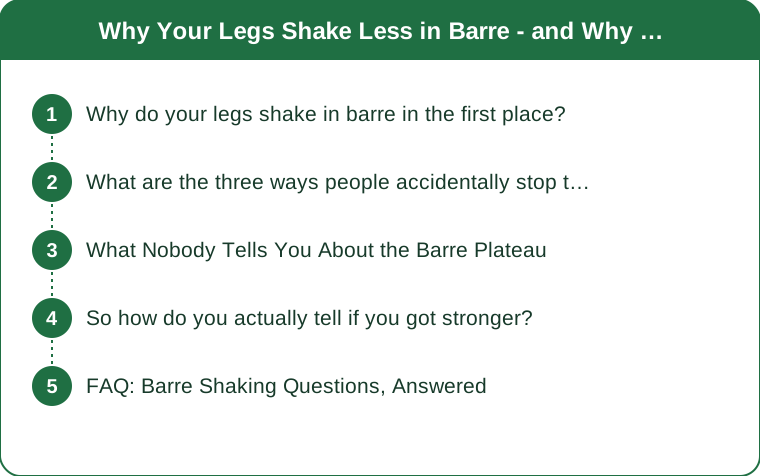
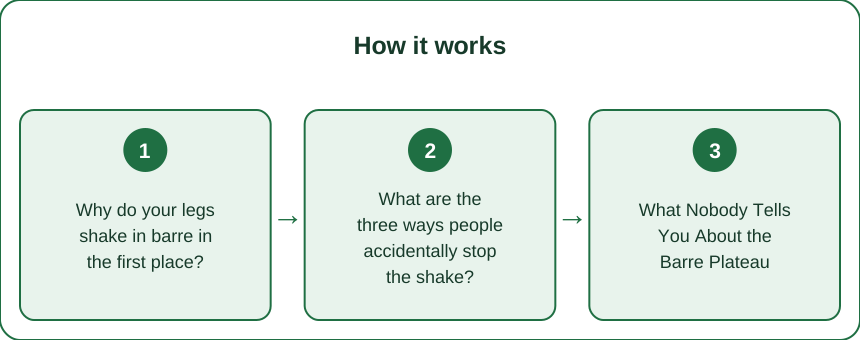
Why do your legs shake in barre in the first place?
Because of what sustained isometric tension asks of your nervous system. In a small-range, long-hold position, you cannot rotate through fresh muscle fibres the way you can in a repeated full-range movement. The same motor units stay recruited, fatigue, and have to be swapped out mid-contraction.
That swapping is the shake. Your nervous system is cycling recruitment in and out to sustain a force it cannot hold with any one group, and the visible tremor is the imperfect handover between them. It is why barre and wall sits produce it so reliably while a set of eight squats does not.
It is also why beginners shake more. Coordination of that handover improves with practice, quite separately from strength. Within about eight to twelve weeks, most people shake less at the same position purely from the nervous system getting better at the task.
So the shake is a real signal, but it is a signal about coordination under fatigue - not a direct measure of how hard the muscle is working. Which is exactly why it can fade for good reasons and bad ones.
What are the three ways people accidentally stop the shake?
All three are invisible from the outside and feel completely natural from the inside.
Gripping the barre. The barre is meant to be a fingertip guide. Under fatigue, hands creep to a full grip and start pulling, which transfers a meaningful share of your bodyweight to your arms. The shake stops because the load dropped. Test: hold the position with only two fingers resting on the barre.
Range creep. In a plie series, a two-centimetre rise over the course of a hold moves you out of the deepest, hardest part of the range. Nobody does this deliberately, and almost everybody does it. Test: set your depth against a fixed reference - a mark on the mirror, or a hand span from the barre.
Weight shift. Sliding your weight backward into your heels or forward onto your toes changes which muscles carry the position. Backward into the heels is the common one, and it turns a quadriceps hold into something the calves and hip flexors quietly share. Test: keep even pressure across the whole foot and notice whether the position suddenly feels harder.

What Nobody Tells You About the Barre Plateau
The plateau usually shows up around month four, and it is a measurement problem before it is a training problem.
Here is the pattern. In months one to three, everything is hard, everything shakes, and progress is obvious. By month four your coordination has caught up, the shaking has settled, and the classes feel manageable. Most people read that as arrival, and their effort quietly drops to match the sensation.
What is actually happening is that the class has become a maintenance dose. Barre is largely bodyweight work at a fixed range, so unlike a weights programme, it does not automatically get harder as you get stronger. The load stayed the same while your capacity rose. That is a plateau built into the format, not a failure of yours.
The second thing nobody mentions: fatigue from other training changes the shake substantially. A leg day two days before class will produce dramatic shaking that has nothing to do with your barre progress, and a rest week will produce none. If you are using the shake as your progress metric, you are also measuring your gym schedule.
The third: some people simply shake less. Muscle fibre distribution and limb length both affect it, and comparing your legs to the person at the next barre tells you nothing useful at all.
So how do you actually tell if you got stronger?
Use three tests that do not depend on sensation.
The hold test. Pick one position - a low plie at a fixed depth, or a single-leg chair hold. Time how long you can hold it with fingertips only on the barre and even foot pressure. Note the number. Retest in four weeks under identical conditions. This is the closest thing barre has to a barbell.
The depth test. At the same hold duration, can you go two centimetres lower than you could a month ago? Depth at constant time is progress just as clearly as time at constant depth.
The recovery test. How long after class do your legs feel normal again? Improving recovery is a genuine adaptation signal and is often the first one to change.
And if all three are flat, the fix is not to try harder in the same class. It is to change the stimulus: add a light ankle weight, slow the tempo of the pulses, increase the hold duration, or add a single-leg variation. Barre progresses through range, tempo, duration, and stability - not through load. Using those levers deliberately is what turns month four into month twelve.
FAQ: Barre Shaking Questions, Answered
Is shaking a sign I am doing it correctly?
It is a sign of sustained tension with fatigue, which usually means you are in the right place. But it is not required, and chasing it can push people into positions they cannot control safely.
Should I stop when I start shaking?
No, provided you can maintain the position and breathe. The shake is not a warning signal. Sharp joint pain, held breath, or losing the shape are the signals to come out.
Why do I shake more some weeks than others?
Sleep, other training, hydration, and where you are in your cycle all affect it, sometimes considerably. Week-to-week variation in the shake is normal and is another reason not to use it as your progress metric.
TL;DR:
- The shake is your nervous system cycling motor units under sustained tension - a coordination signal, not a strength meter.
- It fades honestly when you adapt, and dishonestly when you grip the barre, drift up in range, or shift your weight.
- Test each of those three by removing them: two fingers on the barre, a fixed depth reference, even foot pressure.
- Barre plateaus around month four because the load is fixed while your capacity rises - progress it with tempo, duration, range, and stability instead.
- Measure with a timed hold, depth at constant time, and recovery speed. Not with how much you shake.
If the shake went away and the timed hold went up, you got stronger. If it went away and the hold is the same, your hands got clever. Both are fixable in a single class once you know which one it is.
See It in Motion
Seen here: High Waist Bootcut Yoga Pants with Pockets — shop it on bubblelime.com
Keep Reading
This article is for general informational and styling purposes only. Fit, sizing, and product availability may vary.