Why Your Hip Clicks During Barre Leg Lifts, and When It Actually Matters

Quick Answer: Your hip clicks during barre leg lifts because a tendon at the front of the hip, usually the hip flexor tendon, slides over a bony ridge as the leg moves from lifted to lowered. That’s called snapping hip, it’s common in dancers and barre regulars, and when it’s painless it’s harmless. It happens more in barre because the front leg series is hundreds of slow, low lifts that use the hip flexor more than the glutes. Lower the leg a little less, square the hips, lead with the glute, and stretch the hip flexors after class. Painful clicking, or clicking with a catch, is the version to get checked.
Front series. Leg extended low, toes pointed, 40 tiny lifts. On every lower there’s a click at the front of the hip, loud enough that you glance around to see if anyone heard.
It doesn’t hurt. It’s just there, every class, and it’s been getting more frequent.
Here’s what’s actually moving, and why barre brings it out when running and lifting never did.
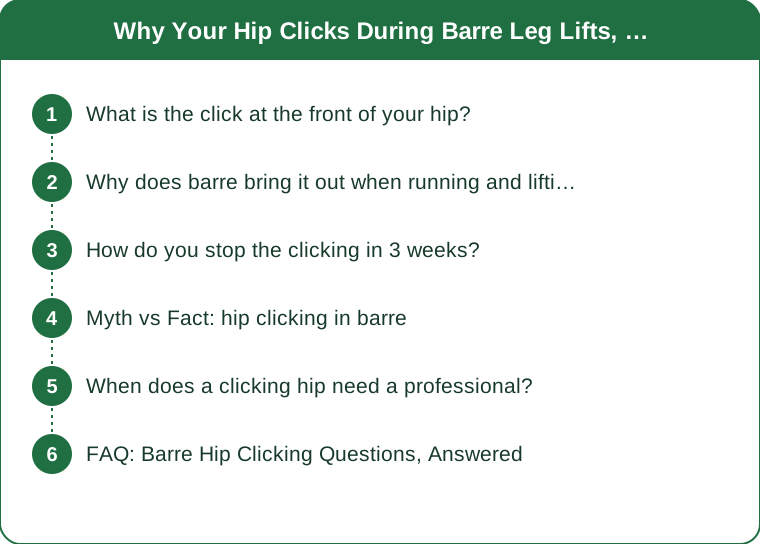
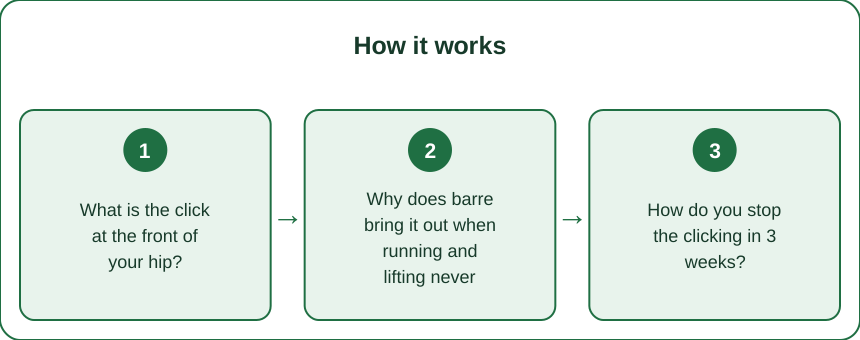
What is the click at the front of your hip?
The front of the hip is crowded. The deep hip flexor, the iliopsoas, runs from the lower spine over the front of the pelvis and down to the inside of the thigh bone. Where it crosses the front of the pelvis there’s a small bony ridge. When the hip moves from bent to straight, the tendon has to slide across that ridge, and if it catches for a moment and then releases, you feel and often hear a click, clunk or pop.
That’s the most common type, and it’s called internal snapping hip. It shows up at the exact moment barre asks for: the leg lowering from lifted toward the floor, especially when the leg is slightly turned out.
There’s a second type on the outside of the hip, where the thick band of tissue down the outer thigh snaps over the bony point of the hip. That one you feel on the side, often in side-lying leg series or in a wide second position.
Both are extremely common. Studies of dancers find snapping in a large majority of them, and most never have pain. A painless snap is a tendon doing something slightly awkward, not a joint falling apart.
Why does barre bring it out when running and lifting never did?
Three things about barre make it the perfect snapping hip trigger.
Volume at the end of the range. A front leg series is often 100 or more lifts in one class, each one taking the hip from slightly bent to fully straight. That’s the exact arc where the tendon crosses the ridge. Running moves through that arc too, but with momentum and far fewer slow, controlled repetitions.
Hip flexor dominance. When the glutes and deep abdominals aren’t fully in the game, the hip flexor does the lifting and the controlling on the way down. A tendon that’s working hard and slightly tight snaps more than one that’s relaxed and sharing the load.
Turnout. A small external rotation of the leg, the ballet position barre borrows, shifts the tendon’s path across the ridge. For some hips, that’s enough to turn a silent slide into an audible click.
Add a long day sitting beforehand, which shortens the hip flexors, and an evening class is almost guaranteed to click.
How do you stop the clicking in 3 weeks?
The goal is to take the work off the hip flexor tendon and give it room to slide. Four changes, applied in every class, usually quiet the click within 2 to 3 weeks.
- Lower the leg less. Stop the lower about 2 inches above where it would click. You lose almost nothing from the exercise, and the tendon never crosses the ridge.
- Square and stack. Hips level, both pointing forward, pelvis in neutral rather than tucked hard or tipped forward. Reduce turnout to a soft angle for the front series.
- Lead with the glute. Before each lift, gently squeeze the glute on the standing leg and the working leg, and think of lifting the leg from the back of the hip rather than the front. The hip flexor still works, but it stops doing everything.
- Stretch the hip flexors after class, not before. Half-kneeling, back knee on a mat, tuck the pelvis under and shift forward until you feel the front of the back hip. 3 holds of 30 seconds each side. Doing this 4 times a week makes more difference than any tweak in class.
Add two short strength moves at home, 3 times a week: glute bridges, 3 sets of 12, and side-lying clamshells, 2 sets of 15 each side. Stronger glutes mean a quieter hip flexor.
Myth vs Fact: hip clicking in barre
Myth: clicking means the joint is wearing down. Fact: painless snapping hip is a tendon sliding over bone, not cartilage grinding. It’s not linked to arthritis and doesn’t predict it.
Myth: you should click it on purpose to release it. Fact: repeatedly forcing the snap irritates the tendon and the small cushion beneath it. That’s how a painless click becomes a painful one. Avoid the click, don’t chase it.
Myth: more stretching before class will fix it. Fact: long static stretches before class relax the muscles you need for control and can make the snap more frequent. Warm up with movement, stretch afterward.
Myth: it only happens to people with weak hips. Fact: it happens to very strong dancers too. Tendon path and bone shape matter as much as strength, which is why the range and alignment changes work even when strength is already good.
When does a clicking hip need a professional?
Most clicks are nothing. These are the ones to get looked at:
- It hurts. A dull ache at the front of the hip after class, or pain with the click itself, usually means the tendon or the small fluid sac under it is irritated. Two weeks of avoiding the snap and doing the stretches usually settles it. If it doesn’t, see a physical therapist.
- It catches or locks. A click that feels like something is briefly stuck, with a sense of the leg giving way, is different from a tendon snap and can involve the joint lining. That one needs an assessment.
- It’s deep inside the groin and painful with sitting or twisting. Same advice, get it checked.
- It started after a fall or a sudden pivot. Any new click with a clear injury behind it should be looked at.
A sports physical therapist can usually tell which type you have in one visit, and the treatment for the common type is exactly what’s above: range, alignment, glute strength and hip flexor length. This is general information, not medical advice.
FAQ: Barre Hip Clicking Questions, Answered
Should I stop going to barre if my hip clicks?
No, unless it hurts. A painless click is a reason to adjust your range and alignment, not to stop. Tell your instructor so they can watch your front series and check your turnout and pelvis position. Most people keep every class and lose the click within a few weeks.
Why does my hip only click on one side?
Almost everyone has one hip that’s slightly tighter, slightly more turned out, or shaped a little differently. That side’s tendon sits closer to the ridge and snaps more easily. Do the hip flexor stretch and glute work on both sides, but give the clicking side an extra set.
Does the click mean I need to foam roll my hip flexor?
Rolling the front of the hip is hard to do well and often just irritates the area. A half-kneeling hip flexor stretch and glute strengthening do more. If you want to use a tool, a soft ball on the outer hip, never pressed into the front of the groin, can ease the outer-hip type of snap.
TL;DR:
- A click at the front of the hip in barre leg lifts is almost always a hip flexor tendon snapping over a bony ridge, common in dancers and harmless when it’s painless.
- Barre triggers it with hundreds of slow, turned-out lifts at exactly the range where the tendon crosses the ridge.
- Lower the leg 2 inches less, square the hips, lead with the glute, and stretch the hip flexors after class 4 times a week.
- Pain, catching, locking, or a click that started with an injury needs a physical therapist.
Try the shorter range in your next front series and see if the click disappears. Then build the glute work and the after-class stretch into the week. Three weeks from now, the only sound in class should be the music.
See It in Motion
Seen here: UPF 50+ Short Sleeve Rashguard Swim Shirt — shop it on bubblelime.com
Keep Reading
This article is for general informational and styling purposes only. Fit, sizing, and product availability may vary.