Why Your Barre Instructor Keeps Saying Ribs Down - and What They Actually Mean

Quick Answer: Ribs down is shorthand for stacking your ribcage over your pelvis so the deep core can actually generate tension. When the front ribs flare upward, the diaphragm and pelvic floor stop facing each other, the deep abdominals lose their leverage, and the low back takes the load instead. The fix is not sucking your ribs in - it is a gentle exhale that lets them settle, held while you keep breathing. That last part is where nearly everyone gets it wrong.
You have heard it forty times. Ribs down. You pull something in, the instructor moves on, and you have no idea what you just did.
The cue is genuinely useful. It is just describing a position by naming the wrong body part.

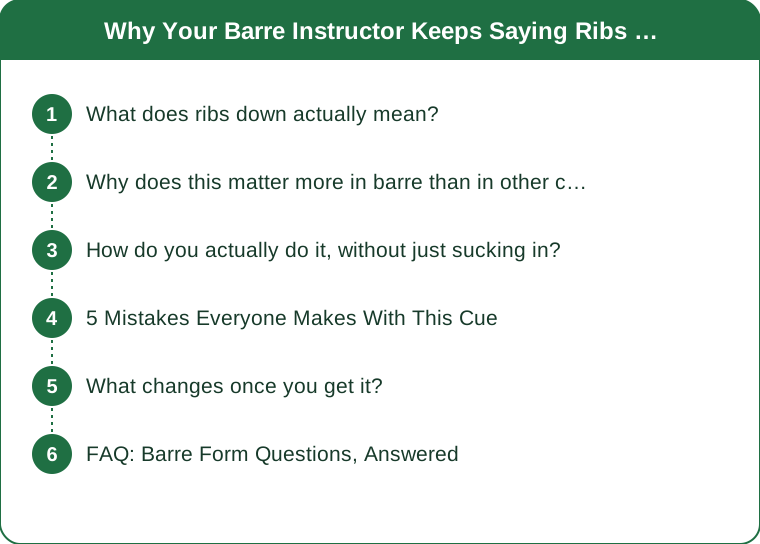
What does ribs down actually mean?
It means getting your ribcage to sit over your pelvis rather than tipped back behind it.
Stand normally and put a hand on the bottom of your breastbone. For a lot of people, especially anyone who spends the day at a desk and then arrives at a barre class, the front of the ribcage sits slightly lifted and tipped upward, with the low back arched to compensate.
When that happens, the diaphragm at the top of your trunk and the pelvic floor at the bottom are no longer roughly parallel. They are angled away from each other, and the deep abdominal wall between them cannot build tension efficiently.
The result is exactly what the instructor is seeing: a lot of visible effort, a low back that is doing the work, and a core that is not really contributing.
So the cue is not asking you to move your ribs. It is asking you to change the relationship between two ends of your trunk.
Why does this matter more in barre than in other classes?
Because barre is built on small-range, high-repetition holds in positions where the low back can easily take over.
Think about what a class actually contains: standing thigh work with a long hold, arms overhead with light weights, glute work on all fours, and core work in a small range. Every one of those positions has a low-back cheat available.
In a lifting session, a heavy load tends to force you into a braced position because nothing else works. In barre, the loads are light enough that a poor position still gets you through the set - you just feel it in the wrong places and wonder why your back is tired and your abs are not.
This is also why arm work is a common trigger. Reaching overhead pulls the ribcage up with it unless you deliberately keep it down, which is why so many people feel their low back during a light weight sequence.
How do you actually do it, without just sucking in?
Use a long exhale, not a squeeze.
Stand tall. Take a normal breath in. Now exhale slowly and fully, all the way to the end, and notice what happens to the front of your ribs - they settle downward on their own. That position, at the bottom of the exhale, is what the cue is asking for.
The hard part is what comes next: keep that position while breathing normally. Not holding your breath, not clenching. Breathe into the back and sides of your ribcage rather than lifting the front.
A useful check: place one hand on your breastbone and one on your pubic bone. In a good position those two points feel like they are gently approaching each other, and the distance stays steady while you breathe.
What it should not feel like: gripping the abdominals hard, holding your breath, or tucking your pelvis under. A hard tuck is the most common overcorrection, and it swaps one problem for another.

5 Mistakes Everyone Makes With This Cue
1. Sucking the stomach in. Pulling the belly button to the spine narrows the waist but does nothing useful for the ribcage position, and it usually stops you breathing well. The ribs are the target, not the stomach.
2. Tucking the pelvis hard. Overtucking flattens the low back, switches off the glutes at exactly the moment you need them, and creates a different set of aches. A small amount of pelvic control is part of the position; a jammed tuck is not.
3. Holding the breath. If the position disappears the moment you inhale, it was breath-holding rather than positioning. The whole test is whether it survives normal breathing.
4. Only doing it when reminded. The cue lands most in the exercises where it is hardest, but the position should be quietly present throughout the class - especially in arms overhead and in any standing thigh hold.
5. Assuming it is a barre thing. It is the same position that matters in lifting, running, and carrying a toddler on one hip. Barre just makes it visible because the ranges are small and the holds are long.
What changes once you get it?
Three things, usually within a couple of weeks.
The first is where you feel the work. Thigh and seat sequences start producing fatigue in the thighs and seat rather than a tired low back. This is the most immediate and most convincing sign.
The second is the shake. Barre shaking is normal and expected, but it tends to arrive earlier and in the right muscles once positioning improves, because those muscles are actually receiving load.
The third is off the mat: standing for a long time, carrying bags, and sitting through a long afternoon all get slightly easier, because the same stacking is what makes those positions sustainable.
One honest caveat - this is a skill, not a switch. Most people need several weeks of deliberate attention before it happens without thinking, and it tends to disappear first when you are tired, which is exactly when the instructor says it again.
FAQ: Barre Form Questions, Answered
Is rib flare bad posture I need to fix permanently?
It is a position, not a defect, and a mildly lifted ribcage is common and often harmless in daily life. What matters is being able to change it when you are loading the body, which is what the cue is training.
Why can I hold it standing but not in plank?
Because plank adds gravity pulling the ribcage away from the pelvis. Regress to an incline plank with hands on a bench, hold the position there, and lower the incline over a few weeks. Almost everyone can hold it somewhere.
Should I feel this in my abs?
You should feel a gentle wrap of tension around the whole trunk, including the sides and back, rather than a hard burn in the front. A hard front-only sensation usually means you are gripping the surface abdominals instead.
Does this help with lower back pain in class?
Often, yes, since the low back tends to take over when the ribcage is not stacked. If back pain persists once your position is genuinely better, or if it is sharp rather than fatigue, that is worth having assessed rather than repeatedly training through. This is general information, not medical advice.
TL;DR:
- Ribs down means stacking the ribcage over the pelvis, not moving your ribs in isolation.
- Flared ribs angle the diaphragm and pelvic floor away from each other, so the deep core loses leverage and the low back takes over.
- Find it with a long full exhale, then keep the position while breathing normally.
- Do not suck in, hard-tuck the pelvis, or hold your breath - all three are common overcorrections.
- Arms overhead is the most common trigger, which is why the cue arrives during light weight work.
- When it clicks, the work moves into thighs and seat and out of your low back.
It is one of those cues that sounds like a nitpick until the day it lands, and then it quietly changes every class after it.
See It in Motion
Seen here: Racerback Tank Top - White — shop similar styles on bubblelime.com
Keep Reading
This article is for general informational and styling purposes only. Fit, sizing, and product availability may vary.