Why You Hold Your Breath in Barre and What It Costs You

Quick Answer: Small isometric pulses at the end of a range make breath-holding almost automatic, because bracing the trunk and breathing feel like competing jobs. The cost is real: held breath spikes blood pressure, cuts endurance in the set, and tightens the neck and jaw. The fix is to exhale on the pulse and inhale on the release - one breath per rep, out loud if the class allows it.
You are ninety seconds into the seat work. Your legs are shaking, the instructor says twenty more, and you notice your jaw is clenched and you have not taken a real breath since the set started. This is not a fitness problem. It is a pattern, and it is trainable.

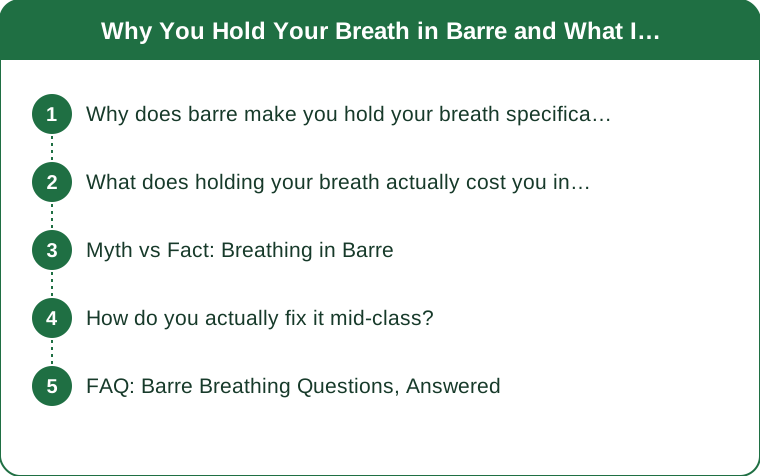
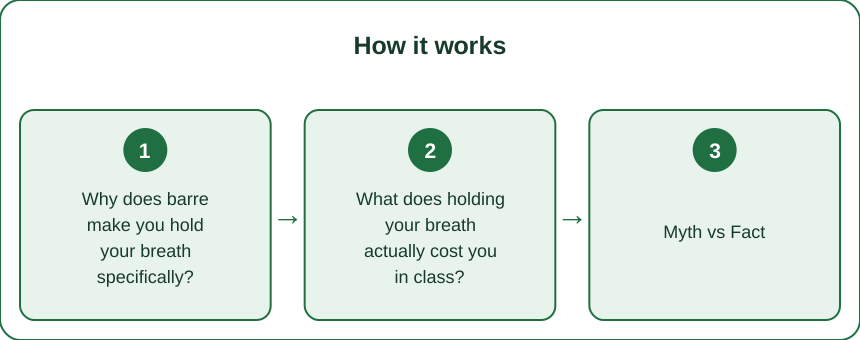
Why does barre make you hold your breath specifically?
Three features of barre stack up in exactly the wrong way.
The pulses are isometric-ish and continuous. In a squat you have an obvious rhythm - down, up, breathe. A one-inch pulse at the bottom of a plie has no obvious inhale window, so the body defaults to holding.
You are cued to brace. Ribs down, core engaged, tuck the pelvis. Bracing the trunk and breathing into it feel contradictory when you are new, so most people solve the conflict by not breathing.
The sets are long. Sixty to ninety seconds of continuous work in a small range is significantly longer than most strength sets, so a held breath that would be harmless for five seconds turns into a full-blown Valsalva for far too long.
Add the concentration - and barre demands a lot of it, since the movements are small and precise - and breath-holding becomes the default rather than the exception.
What does holding your breath actually cost you in class?
Four things, roughly in order of how much you will notice them:
Your set ends early. With no fresh oxygen arriving, a muscle working continuously fatigues faster. Those last ten reps you cannot finish are frequently a breathing issue rather than a strength one.
Your blood pressure spikes. Holding your breath against a closed throat while muscles contract raises blood pressure sharply, then drops it on release. That is the source of the light-headedness people feel when they stand up after floor work. If you have any cardiovascular condition or are pregnant, this matters more than a nuisance.
Your neck and jaw take the load. Clenching your jaw and gripping your neck are part of the same bracing strategy. It is why people leave barre with a sore neck after a class that never worked the neck.
Your shaking gets worse. Not entirely - the shake is largely motor unit cycling and is normal - but oxygen debt makes it more pronounced and less controlled, which makes the position harder to hold.

Myth vs Fact: Breathing in Barre
Myth: Holding your breath makes your core stronger. Fact: Bracing and breath-holding are different things. You can maintain trunk stiffness while breathing laterally into the ribs. Powerlifters hold their breath deliberately for a single heavy rep lasting a couple of seconds - not for ninety seconds of pulses.
Myth: You should breathe in through the nose and out through the mouth, always. Fact: For a long, demanding set, whatever gets air in reliably is correct. Nasal breathing has real benefits at low intensity and is not worth defending when your legs are shaking.
Myth: If you are breathing hard in barre, you are doing it wrong. Fact: Elevated breathing during long isometric sets is a normal response to local muscular demand. Silent, effortless breathing throughout usually means the load is too light.
Myth: The tuck cue means you should not let your belly move at all. Fact: The tuck refers to pelvic position. Your ribcage can still expand sideways and backwards, and that is where the breath should go.
Myth: You will just naturally start breathing once you are fitter. Fact: Breath-holding under bracing is a motor pattern, and patterns get more ingrained with repetition, not less. It has to be practised deliberately.
How do you actually fix it mid-class?
Start with the simplest cue and only add complexity if it does not work.
Match one breath to one rep. Exhale on the pulse or lift, inhale on the release. In fast pulse sections, exhale every second pulse. Having any rhythm at all beats having none.
Breathe out audibly. A quiet hiss through pursed lips is impossible to do while holding your breath, which is the point - it makes the failure obvious. Most instructors are entirely happy with this.
Breathe into the sides and back of the ribcage, not the belly. Put your hands on your lower ribs during the warm-up and feel them widen sideways. This is the breath that coexists with a braced trunk, and it is the one to practise.
Unclench the jaw as your check-in. Every time you notice a tight jaw, that is your signal that the breath went. Letting the tongue rest on the floor of the mouth and softening the jaw usually restarts the breath on its own.
Use the transitions. Two full breaths between sets, while the instructor is setting up the next section, resets you far more than you would expect.
Practise this in the easiest section of class, not the hardest. If you can only hold the pattern during thigh work, you have not learned it yet.
FAQ: Barre Breathing Questions, Answered
Why do I feel dizzy during barre?
Most often from holding your breath during long pulse sets, which spikes and then drops blood pressure. Standing up quickly after floor work makes it worse. If dizziness happens regularly even when you are breathing steadily, that is worth raising with a doctor rather than working around.
Should I breathe in or out during the pulse?
Exhale on the effort - the pulse or the lift - and inhale on the release. If the pulses are too fast to match one to one, exhale on every second one. Consistency matters more than which precise phase you pick.
Why does my neck hurt after barre when we never worked the neck?
Breath-holding recruits the neck and jaw as part of the bracing strategy, and long sets mean long clenching. Restoring the breath usually resolves it within a few classes. Persistent neck pain is worth having looked at.
Is it normal to breathe heavily in a barre class?
Yes. Long isometric and small-range work creates a large local oxygen demand even though the class is not cardio in the traditional sense. Heavy breathing is a sign the load is appropriate, not a sign of poor fitness.
TL;DR:
- Small continuous pulses give no obvious inhale window, so holding your breath becomes the default.
- The cost is earlier fatigue, blood pressure swings, a clenched jaw and neck, and a worse shake.
- Bracing and breathing are not in conflict - breathe sideways into the lower ribs, not the belly.
- Exhale on the effort, inhale on the release, and make the exhale audible so you notice when it stops.
- A tight jaw is your reliable signal that the breath went missing.
Practise the pattern in the warm-up, where it is easy. What you can do under no load is what you keep when your legs start shaking.
See It in Motion
Seen here: High Waist 8” Yoga Shorts — shop similar styles on bubblelime.com
Keep Reading
This article is for general informational and styling purposes only. Fit, sizing, and product availability may vary.