Why Your Legs Shake in Barre - and When to Stop

Quick Answer: The shake is your nervous system cycling motor units in and out to keep a long, low-level contraction going. It is normal, it is not a sign of muscle damage, and it does not mean you are burning more fat. Keep going while the shake is rhythmic and your position is holding. Stop when the shake becomes a lurch, your hips drop, or your knee starts drifting inward.
Every barre class has a moment where a room full of people looks like a room full of tuning forks. The instructor says shake means change, everyone laughs, and nobody explains what is actually happening in the leg.

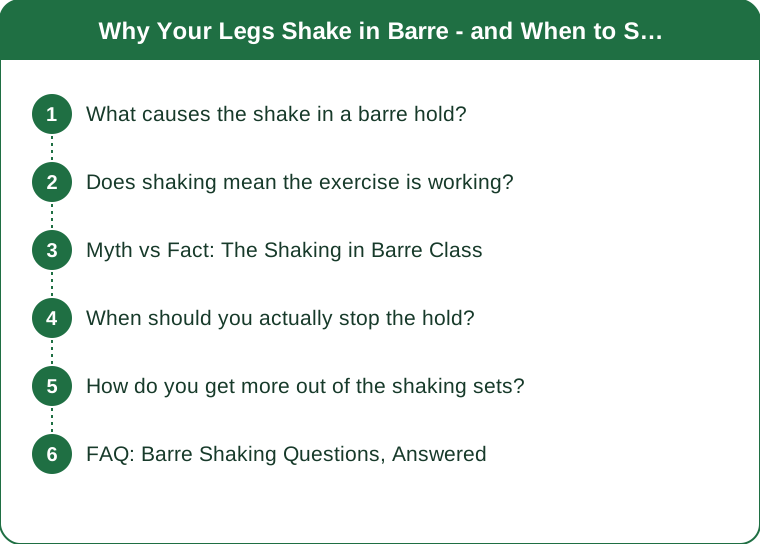
What causes the shake in a barre hold?
Muscles do not contract as one solid block. They fire in units - a nerve plus the fibers it controls - and during a long, moderate hold your body rotates through them so no single group has to work continuously.
Early in a hold, that rotation is smooth and invisible. As the available units fatigue, the handoffs get coarser: one group lets go a moment before the next picks up, and the limb oscillates in the gap. That is the shake. It is a motor-control phenomenon, not a damage signal.
It shows up in barre more than in most training because barre lives in exactly the range that produces it: small pulses and long holds at maybe 20-40% of maximum effort, sustained for 60 seconds or more. A heavy 5-rep squat never lasts long enough. A slow walk never demands enough. Barre sits in the uncomfortable middle on purpose.
Does shaking mean the exercise is working?
Partly - and the honest answer is more useful than the studio version.
The shake does tell you the muscle is deep into a fatigued state and that you are recruiting broadly. That is real, and it is a decent proxy for effort in an isometric hold.
The shake does not tell you that you are building more muscle, burning more calories, or reaching some special metabolic zone. Two people in the same plie can shake at wildly different points depending on training history, hydration, caffeine, sleep, and how many times they have done that exact hold this month. Someone who is not shaking is not necessarily coasting.
More useful than watching your quads: watch your position. A hold done at a consistent depth for 45 seconds beats a hold that sank three inches while shaking dramatically. Depth and stillness are the load. The tremor is just the readout.
Myth vs Fact: The Shaking in Barre Class
Myth: Shaking means you are tearing muscle fibers and that is how you tone. Fact: Tremor is neural, not structural. Muscle adaptation comes from tension and effort over weeks, not from how visible your quads were on Tuesday.
Myth: If you are not shaking, you are not working hard enough. Fact: Trained legs often hold longer before the handoffs get coarse. Beginners frequently shake in 20 seconds and advanced students at 90. The clock is a better metric than the tremor.
Myth: Shaking burns more calories. Fact: Tremor adds a trivial amount of energy expenditure. Total work, session length, and consistency dominate by an enormous margin.
Myth: You should always push through the shake. Fact: Push through the rhythmic phase. Once the shake turns into a lurch - a large, irregular drop - the position has already degraded and you are now training the compensation instead of the target muscle.
Myth: Shaking means you will be sore tomorrow. Fact: Soreness tracks with eccentric loading and novelty far more than with tremor. Plenty of shake-heavy classes produce almost no next-day soreness.

When should you actually stop the hold?
Use three checkpoints, in this order.
1. The knee line. In any single-leg or plie position, if the knee starts tracking inward past the second toe, stop. That collapse is the most common form breakdown in barre and the one most associated with knee irritation.
2. The pelvis. If your hips are dropping, tucking hard, or rotating to one side to buy another five seconds, the target muscle has already handed the job to something else.
3. The rhythm. A fine, fast, regular tremor is fine. A slow, large, irregular lurch means you are past useful. That transition usually happens within 5-10 seconds, and it is quite noticeable once you know to look for it.
When you hit any of the three, come out halfway rather than all the way. Rising an inch or two out of the deepest position and holding is far better than collapsing entirely and standing there for the last 20 seconds. The set continues, the position stays honest, and you get the last stretch of work that everyone else in class skips.
How do you get more out of the shaking sets?
Breathe on a count. People hold their breath through tremor without noticing. Try 3 counts in, 3 counts out for the length of the hold - it steadies the tremor noticeably and keeps you present for the last 15 seconds, which is the part that matters.
Push into the floor, not down into the pose. Actively pressing through the whole foot recruits more of the leg and reduces the tendency to sink.
Use the barre lightly. Two fingers, not a grip. Gripping shifts load off the legs, which is exactly what you came to load.
Track a clock, not a feeling. If your usual plie hold breaks at 40 seconds, aim for 45 next week. That is a clear progression, and it is far more reliable than trying to shake more.
Do not chase the shake with caffeine. A large pre-class coffee can produce tremor that has nothing to do with muscle recruitment and makes your form feedback less readable.
FAQ: Barre Shaking Questions, Answered
Is shaking in barre dangerous?
No, in a healthy person doing a controlled hold. It is a normal fatigue response. What can cause problems is holding a collapsed position through it, especially with the knee falling inward.
Why do I shake more on one side?
Side-to-side differences in strength and motor control are extremely common and mostly unremarkable. If the gap is large and persistent over months, or one side also feels weak in daily life, get it looked at.
Will I stop shaking as I get fitter?
Usually the onset moves later rather than disappearing. You will shake at 90 seconds instead of 30 - and then the instructor will add a pulse and you will shake anyway. That is the design of the format working as intended.
TL;DR:
- The shake is your nervous system rotating motor units during a long, moderate hold - neural, not damage.
- It signals effort, not superior results. Depth and duration are the real load.
- Keep going while the tremor is fine and rhythmic; stop when the knee drifts in, hips drop, or the shake turns into a lurch.
- Come out halfway rather than collapsing, and progress by seconds held rather than by how much you shook.
The shake is a fun studio moment and a mediocre metric. Use it as a signal that you are in the right zone, then judge the set by whether your knee and hips held their line for the full sixty seconds.
See It in Motion
Seen here: High Waist Bootcut Yoga Pants with Side Pockets — shop it on bubblelime.com
Keep Reading
This article is for general informational and styling purposes only. Fit, sizing, and product availability may vary.