Why Does the 'Barre Shake' Show Up in Different Muscles Depending on Your Shoe Choice?
Quick Answer: Barre socks, bare feet, and sneakers each change your center of pressure, arch engagement, and ankle stability in small but meaningful ways, which shifts the “shake” — that muscular fatigue tremor — into different muscle groups. Grip socks encourage more intrinsic foot and arch work because there’s no rigid sole to distribute pressure for you. Bare feet spread pressure differently across the whole foot and rely heavily on toe splay for balance, often shifting fatigue into the calves and outer ankle. Sneakers add a stiff, cushioned platform that reduces foot-muscle demand but can push more of the stabilizing work up into the knees and hips. None of these is “correct” — they’re just different biomechanical paths to the same fatigued muscles.
If you’ve ever switched from your usual grip socks to bare feet (or grabbed sneakers because you forgot your socks) and noticed your body shaking in a completely different place by the end of class, you’re not losing your mind. Barre work is built on tiny, isometric-heavy movements — pulses, holds, small ranges — and the foot is the very first contact point in that entire chain. Change what’s between your foot and the floor, and you change how force travels up through your ankle, shin, knee, and hip before it ever reaches the muscle the exercise is “supposed” to target.
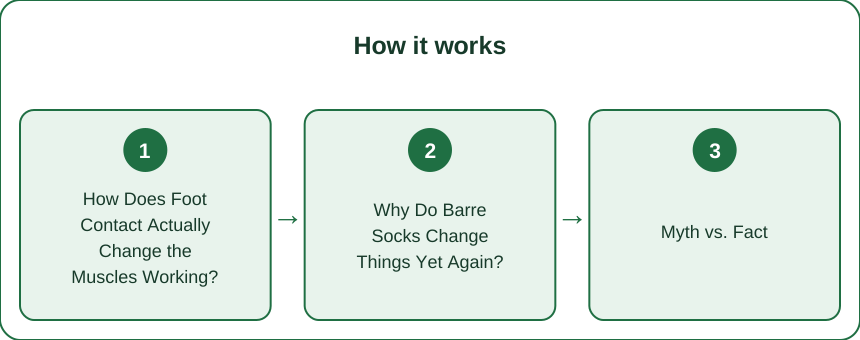
How Does Foot Contact Actually Change the Muscles Working?
Every barre movement — from a plié to a tiny leg lift at the barre — starts with your foot finding and holding a stable base. The muscles responsible for that stability are the intrinsic foot muscles (small stabilizers inside the arch), the extrinsic muscles running from your shin and calf into your foot, and a chain of ankle stabilizers that adjust constantly to keep you from wobbling.
What you wear on your feet changes how much work each of these groups has to do. A rigid, cushioned sneaker sole spreads your body weight across a wide, stable platform and absorbs a lot of the micro-adjustments your foot would otherwise have to make itself. That’s genuinely useful for high-impact cardio, but in barre’s slow, controlled holds, it means your intrinsic foot muscles get to coast while your knees and hips pick up more of the balancing workload — which is why some people feel sneaker-barre fatigue show up higher in the leg.
Bare feet remove that buffer entirely. Your skin is in direct contact with a smooth, often slightly slick studio floor, so your toes and arch have to actively grip and adjust in real time to prevent sliding, especially during pulses or relevés. That constant low-level gripping recruits the flexor muscles running down the back of your calf into your toes, which is a big reason bare-foot barre classes tend to produce a distinctly different — often more calf-and-ankle-centered — burn than the same class in sneakers.
Why Do Barre Socks Change Things Yet Again?
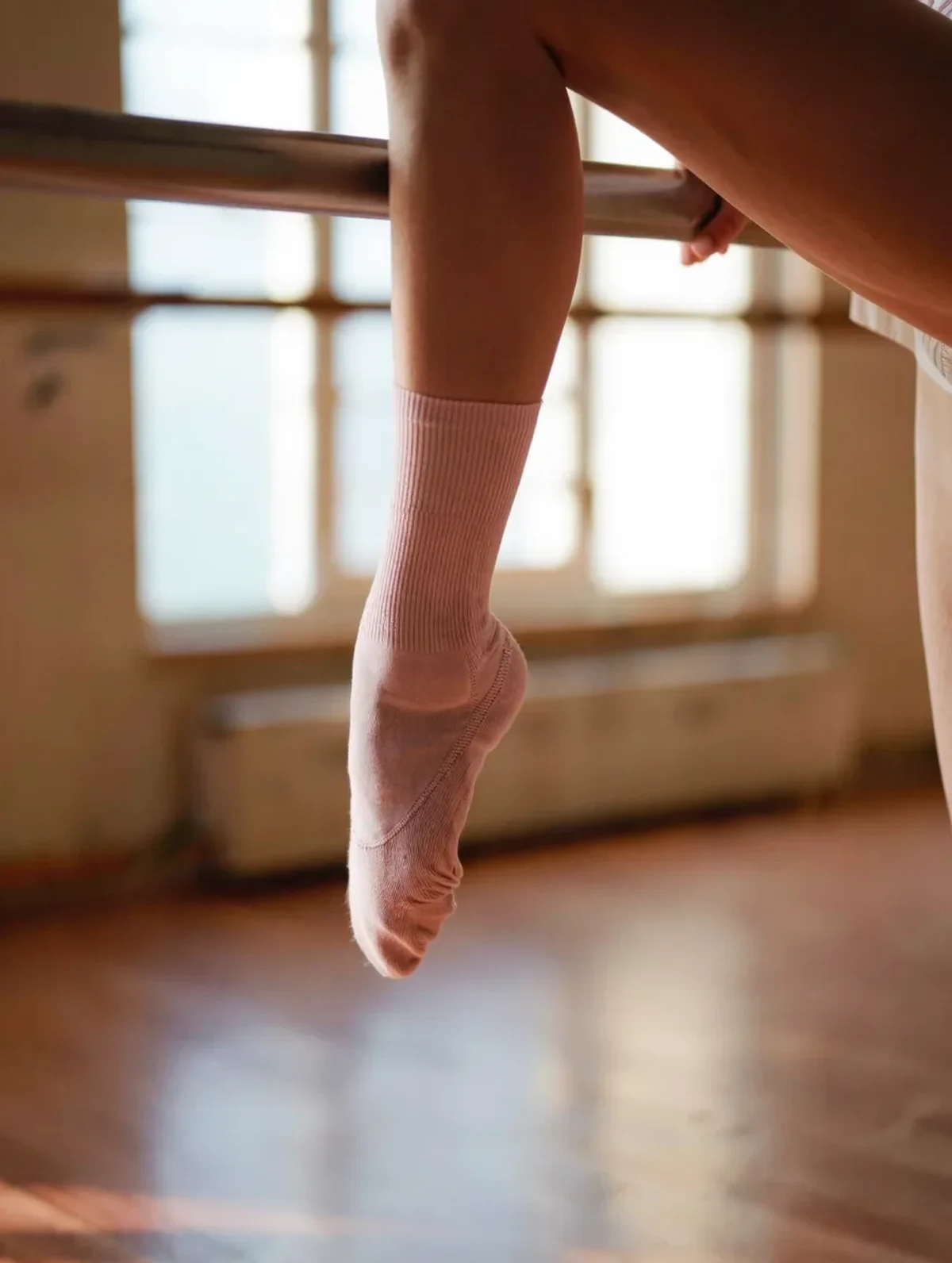
Grip socks sit in an interesting middle ground. The rubberized dots or strips on the sole prevent sliding (similar benefit to bare feet for stability) without providing the rigid structural support of a sneaker. That means your foot still has to actively stabilize itself — there’s no stiff sole doing the job for you — but you’re not relying purely on skin friction against the floor.
This combination tends to load the arch and midfoot stabilizers more evenly than either bare feet or sneakers. Because the sock fabric compresses slightly and molds to your foot shape, you get a small amount of proprioceptive feedback (you can feel your arch working) while the grip pattern handles the traction bare feet have to generate through muscular effort alone. Many regular barre-goers report that socks shift the shake toward the arch and the muscles just above the ankle, rather than deep into the calf belly the way bare feet often do.
There’s also a temperature and moisture factor worth mentioning: bare feet and thin socks let you feel the floor’s actual surface, and studio floors can vary in grip depending on humidity and how recently they were cleaned, which adds a small variable to how hard your foot has to work class to class regardless of footwear.
Myth vs. Fact: Barre Footwear and Muscle Engagement
Myth: Bare feet are always the “purest” or most effective way to do barre. Fact: bare feet emphasize calf and ankle stabilizers because they demand active gripping, but that’s a difference in where the work happens, not a universal upgrade in effectiveness. If your goal is glute and outer-hip work, a stable base (socks or a barre shoe) can actually let you focus force higher up the chain instead of spending it on foot-gripping.
Myth: Sneakers make barre “easier.” Fact: sneakers reduce demand on the small foot stabilizers, but they don’t reduce total effort — they redistribute it. Many people find their quads and hips work harder in sneakers precisely because the ankle isn’t doing as much of the balancing.
Myth: Grip socks are just bare feet with less mess. Fact: the compression and traction pattern of a sock genuinely changes the muscle recruitment pattern compared to skin-on-floor contact, particularly around the arch.
Myth: The shake location tells you which shoe is “right” for you. Fact: shake location reflects which muscles are currently fatiguing fastest under that specific setup — it’s informative, not prescriptive. Rotating footwear over time can actually be a useful way to train stabilizers more evenly.
Myth: You should always match your studio’s default recommendation. Fact: many studios default to grip socks for hygiene and insurance reasons, not because it’s biomechanically superior — it’s worth trying bare feet or supportive shoes occasionally (where allowed) to feel the difference yourself.
Which Foot Contact Should You Choose for Your Goals?
If you’re chasing a stronger, more defined arch and ankle, bare feet (in a clean, appropriate studio) or minimal grip socks will get you there faster, since they force your intrinsic foot muscles to do real stabilizing work every single rep. If your priority is protecting cranky knees or ankles while still getting a strong hip and glute burn, a supportive sneaker or barre-specific shoe with a firm sole gives your foot a break and redirects that stabilizing demand upward.
Grip socks remain the most balanced everyday choice for most people — enough traction to move confidently, enough lack of structure to keep your foot honestly engaged. The real takeaway is that switching your footwear periodically isn’t inconsistency; it’s a low-effort way to make sure you’re not training the exact same narrow set of stabilizers class after class.
TL;DR:
- Footwear changes where the “barre shake” shows up because it changes how much stabilizing work your foot muscles do versus your ankle, knee, or hip.
- Bare feet demand active toe and arch gripping, often shifting fatigue into the calves and outer ankle.
- Sneakers provide a rigid, cushioned platform that reduces foot-muscle demand but can push stabilizing work higher up the leg.
- Grip socks sit in between, loading the arch and midfoot more evenly without a rigid sole doing the work for you.
No single footwear choice is “correct” — rotating between them is a simple way to train your stabilizers more evenly over time.
See It in Motion
Seen here: Super High Waist Embossed Yoga Leggings with Inner Pocket — shop it on bubblelime.com
Keep Reading
This article is for general informational and styling purposes only. Fit, sizing, and product availability may vary.