Why Does Arm Work Burn Differently in a Cold Studio vs. a Warm One?

Quick Answer: Cold muscles conduct nerve signals more slowly and produce less force per contraction than warm ones, so the same light-weight, high-rep arm sequence can feel noticeably harder — and burn faster — in an underheated fall studio than in a fully warmed-up summer room. Blood flow to the small muscles of the arms is also slower to ramp up in cold air, which delays the delivery of oxygen and fuel those muscles need for high-rep endurance work. As studios switch heating systems on for the season, temperature swings between classes (and even within one class) can make your usual arm track feel inconsistent week to week, even though nothing about your strength has changed.
There’s a specific kind of confusion that hits every October: you do the same three-pound-weight, hundred-pulse arm sequence you’ve done for months, and it either burns way faster than usual or barely registers at all — depending on whether the studio’s heat has kicked in yet. This isn’t in your head, and it’s not really about “warming up” in the motivational sense. It’s about actual muscle-tissue temperature, and it has a real, measurable effect on high-rep isometric work like barre arms.
Why Does Muscle Temperature Matter So Much for Light-Weight, High-Rep Work?
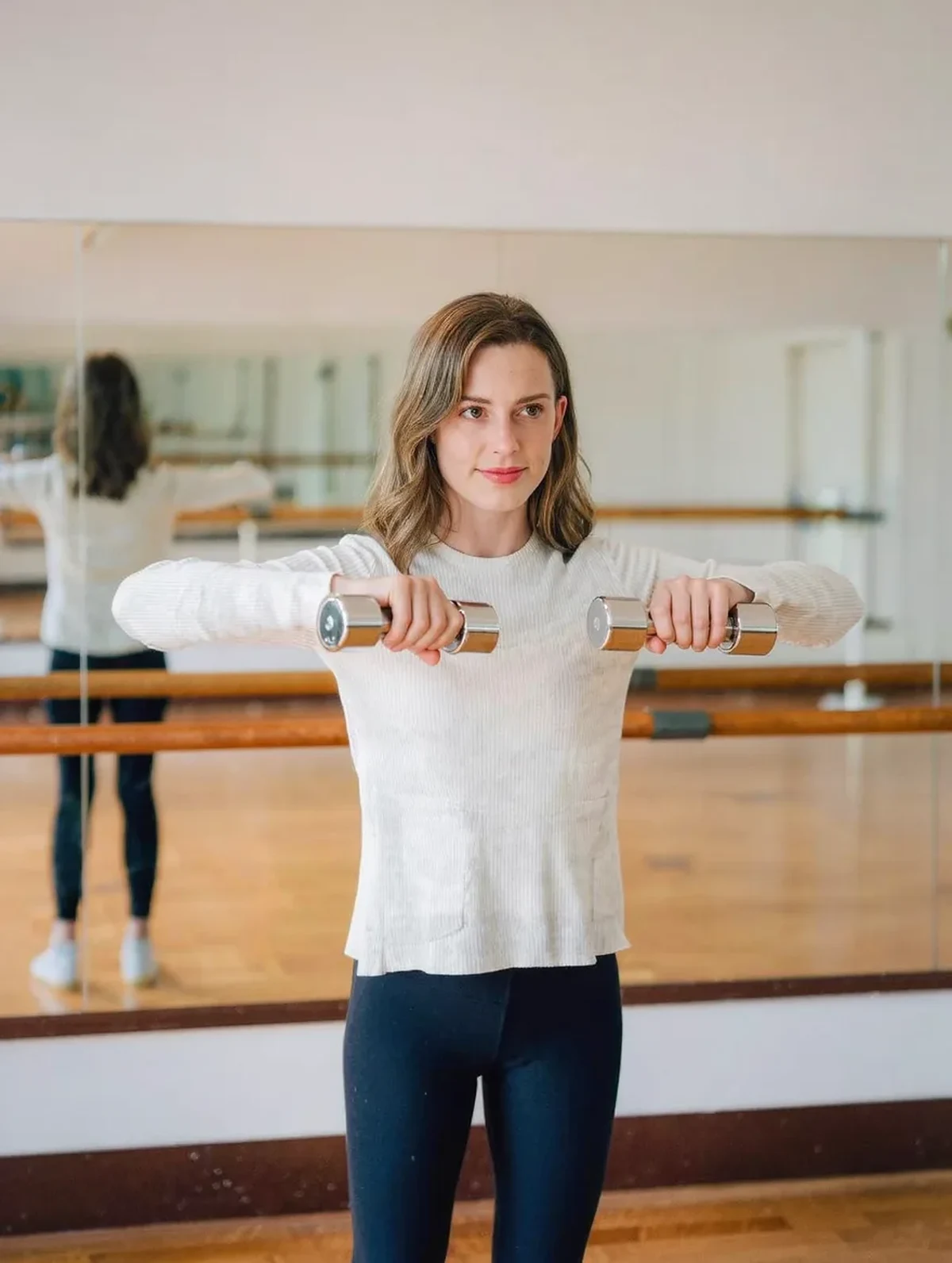
Barre arm sequences are built around high repetition at low load — small pulses with 2–5 pound weights, held isometric positions, tiny ranges of motion repeated dozens of times. This style of training relies heavily on efficient, fast-firing motor unit recruitment and steady blood flow to clear metabolic byproducts and deliver fuel, because you’re not resting between reps the way you would with heavier, lower-rep lifting.
Cold muscle tissue conducts nerve impulses more slowly — the biochemical reactions inside muscle fibers, including the release and reuptake of calcium that triggers contraction, run less efficiently at lower temperatures. In practice, that means each individual pulse in a cold arm requires slightly more effort to produce the same force as it would in a warm one. Multiply that tiny inefficiency across 100+ reps in a single arm track, and the cumulative fatigue arrives noticeably earlier.
There’s also a circulation piece. Blood vessels in your skin and extremities constrict in cold air to preserve core body heat, a reflex called vasoconstriction. That’s great for keeping your core warm, but it means less blood — and less delivered oxygen and glucose — reaches your biceps, triceps, and shoulder stabilizers right when a high-rep set is demanding a steady fuel supply. Your arms are, quite literally, running on a smaller supply line in a cold room.
Why Does the Same Sequence Feel Easier in a Warm Studio?
In a properly heated studio, the opposite chain of events happens. Warmer muscle tissue has faster, more efficient contraction-relaxation cycling, meaning each pulse in your arm sequence costs slightly less energy. Blood vessels dilate rather than constrict, so oxygen and glucose delivery to the working muscles keeps pace with demand for longer, pushing back the point where lactate and other fatigue byproducts start to accumulate faster than your body can clear them.
Warmth also affects muscle viscosity — cold muscle tissue is measurably stiffer, and that added internal resistance means more of your effort in each rep goes toward simply moving through the stiffness rather than producing useful force. A warm room effectively removes that tax, so more of your effort each rep converts directly into the burn you’re chasing rather than being lost to tissue stiffness.
This is exactly why a lot of studios build in a longer warm-up sequence — hip circles, arm swings, light cardio pulses — during the shoulder-season months when heating systems are still catching up to the outdoor temperature drop. It’s not filler; it’s compensating for a real physiological gap between a 62-degree room and a 78-degree one.

5 Mistakes People Make During Autumn Temperature Swings
Heating season creates a specific set of avoidable missteps worth watching for.
Mistake 1: Skipping arm-specific warm-up in a cold room. General warm-up raises your core temperature, but the small muscles of the arms and shoulders benefit from a few dedicated warm-up reps with just the weights, not just jumping jacks.
Mistake 2: Assuming a harder burn means a better workout. A faster burn in a cold studio often reflects inefficient force production, not superior muscle recruitment — it can just mean you’re fatiguing before you’ve done meaningful volume.
Mistake 3: Wearing short sleeves in an unheated early-fall studio. Keeping your arms covered with a light long-sleeve until the room warms up helps maintain local muscle temperature and blood flow, directly reducing the cold-tissue penalty.
Mistake 4: Ignoring first-class-of-the-season inconsistency. Comparing your rep count or “shake point” week over week without accounting for room temperature leads to false conclusions about your progress or regression.
Mistake 5: Overloading weight to compensate for a sluggish-feeling arm. Reaching for heavier weights because a cold room made your usual set feel too easy at first (before the burn catches up) can lead to overuse strain in already stiffer, less pliable cold tissue.
How Should You Adjust Your Arm Work for the Season?
Layer strategically rather than stripping down — a light, breathable long-sleeve keeps your arm muscles closer to optimal temperature without overheating your core once the room catches up. Spend an extra thirty to sixty seconds doing small arm circles or light pulses with just your hands (no weights) before your instructor calls for the weighted set; this pre-warms the exact tissue that’s about to be asked to do repetitive isometric work.
Finally, treat the first two or three classes after your studio switches its heating over for the season as a recalibration period rather than a benchmark. Your rep counts, shake points, and perceived effort will genuinely vary with room temperature — that’s physiology, not inconsistency on your part, and it evens out once both you and the room have adjusted to the season.
TL;DR:
- Cold muscle tissue conducts nerve signals more slowly and produces less force per contraction, making high-rep arm work fatigue faster in an underheated studio.
- Vasoconstriction in cold air reduces blood flow to your arms right when high-rep sets need a steady fuel supply.
- Warm muscle tissue is less viscous, so more of your effort converts into useful contraction instead of fighting internal stiffness.
- A light long-sleeve layer and a brief unweighted arm warm-up can offset most of the cold-studio penalty during heating season.
Treat the first few classes after your studio’s heat kicks on as a recalibration period, not a fitness setback — your arms are adjusting to the room, not losing strength.
See It in Motion
Seen here: High Waist Bootcut Yoga Pants with Pockets — shop it on bubblelime.com
Keep Reading
This article is for general informational and styling purposes only. Fit, sizing, and product availability may vary.