Why Do Your Posture Cues Feel Different in Bulkier Fall Layers?

Quick Answer: Bulkier fall layers — sweatshirts, joggers, oversized zip-ups — add fabric between your skin and the instructor’s hands-on cues, which dulls the proprioceptive feedback you rely on to feel “ribs down” or “tailbone tucked.” Thicker fabric also compresses differently at the waist and hips, masking small shifts in your pelvis and rib cage that you’d normally catch instantly in a fitted tank. The fix isn’t more layers off — it’s re-anchoring your cues to bonier landmarks you can still feel through fabric, and doing a mirror check instead of relying purely on sensation for the first few classes of the season.
You know the feeling: it’s the first genuinely chilly morning of the season, you throw a hoodie over your leggings, and suddenly your instructor’s favorite cue — “ribs knit down, tailbone long” — feels like it’s coming from a different body. You’re not imagining it, and you haven’t lost your form overnight. What’s actually happening is a feedback problem, not a strength problem, and once you understand why fabric bulk messes with your body awareness, the fix takes about one class to sort out.
What Actually Changes When You Add Fall Layers?
Your body figures out where it is in space using proprioception — sensory input from skin, joints, and muscle spindles that tells your brain “my ribs just flared forward” before you’d ever see it in a mirror. A big chunk of that feedback in barre comes from skin contact: a fitted tank lets you feel the subtle stretch and compression across your abdomen the instant your ribs pop out. A loose sweatshirt or a quarter-zip with a full lining absorbs that same movement into slack fabric instead of your skin, so the signal arrives late, or not at all.
There’s a second layer to this (literally). Thicker fabric has more mass and drape, which means it moves independently of your torso for a beat after you do. That lag is small — a fraction of a second — but it’s enough to throw off the instant self-correction most regular barre-goers have built up over months of classes in tanks and fitted tops. You’re not weaker in October; your sensor system just got a blanket thrown over it.
Joggers do something similar at the hip. A fitted legging telegraphs every millimeter of pelvic tilt through compression against your skin, which is exactly how you “feel” a tuck before you consciously think about it. Roomier joggers, especially fleece-lined ones, add a buffer of trapped air and loose fabric at the waistband, so the same tilt has to get bigger before you notice it. Nothing about your core strength changed between September and October — your access to real-time feedback just got quieter.
Why Does “Ribs Down” Specifically Feel Impossible in a Hoodie?
The “ribs down” cue is asking you to prevent your rib cage from flaring forward and up, which is a movement of only a few degrees in most people. It’s one of the smallest-range cues in the entire barre vocabulary, which is exactly why it’s so sensitive to feedback quality. In a fitted top, you feel the fabric across your sternum and lower ribs shift the instant they move — it’s almost like a built-in early-warning system stitched right into the shirt.
Bulky layers change the geometry, too. A drawstring hoodie or a fleece with a kangaroo pocket adds horizontal fabric tension across the front of your body that isn’t there in a tank. That tension can actually mask a rib flare visually (the fabric doesn’t move much even if your ribs do), while simultaneously reducing the skin-contact feedback that would otherwise catch it. You’re essentially fighting the cue with two hands tied — no visual cue in the mirror, and a delayed sensory cue from your own skin.
There’s also a subtle postural effect from the layer itself: heavier fabric sitting on your shoulders and upper back, especially a half-zip with any weight to it, can nudge your shoulders and upper ribs forward just from gravity and drape, particularly if the garment is a size up. That’s not your muscles losing the fight — it’s a few extra ounces of fabric adding a forward pull that wasn’t in your September equation.

Does the Same Thing Happen With “Tailbone Tucked”?
Yes, and for a related but distinct reason. The tailbone-tuck cue relies on you feeling a subtle posterior rotation of your pelvis — often just a couple of degrees — translated through glute and deep abdominal engagement. In fitted leggings, that rotation shows up as a shift in fabric tension across your seat and lower back almost immediately.
Add a looser jogger or a longer overshirt that covers your hips, and two things happen. First, the fabric slack means the same pelvic rotation produces less noticeable tension change — you have to tuck further before you feel anything. Second, if the top layer is long enough to cover your waistband, you lose the visual reference point of seeing your own hip crease in the mirror, which most people use as an unconscious secondary check. Without the visual or the sensory cue, the tuck can quietly under-fire by 30–40% of its usual range and feel completely normal to you in the moment.
5 Mistakes People Make When Adjusting to Fall Layers
Getting caught off guard by this seasonal shift is common, and most of the missteps are easy to fix once you name them.
Mistake 1: Assuming it’s a strength regression. The instinct in October is to think “I got weaker over summer,” which sends people chasing more reps instead of better feedback. Nothing measurable has changed in your muscles in a two-week span.
Mistake 2: Sizing up instead of layering smart. Grabbing a hoodie a size too big to feel “cozier” maximizes exactly the fabric slack that’s dulling your cues. A fitted base layer under a looser top preserves skin contact where it matters.
Mistake 3: Skipping the mirror check. When sensory feedback drops, visual feedback should pick up the slack — but most people layer up and then face away from the mirror out of habit or self-consciousness.
Mistake 4: Ignoring instructor hands-on corrections. A hands-on cue through a thick sweatshirt still works, but you have to consciously log where the touch landed, since you can’t feel your own shift as clearly afterward.
Mistake 5: Not warming up the actual cue. Doing one slow, exaggerated rep of the ribs-down or tailbone-tuck position before class starts, in whatever you’re wearing, recalibrates your sense of “normal” for that layer.
How Do You Reset Your Cues for Cold-Weather Class?
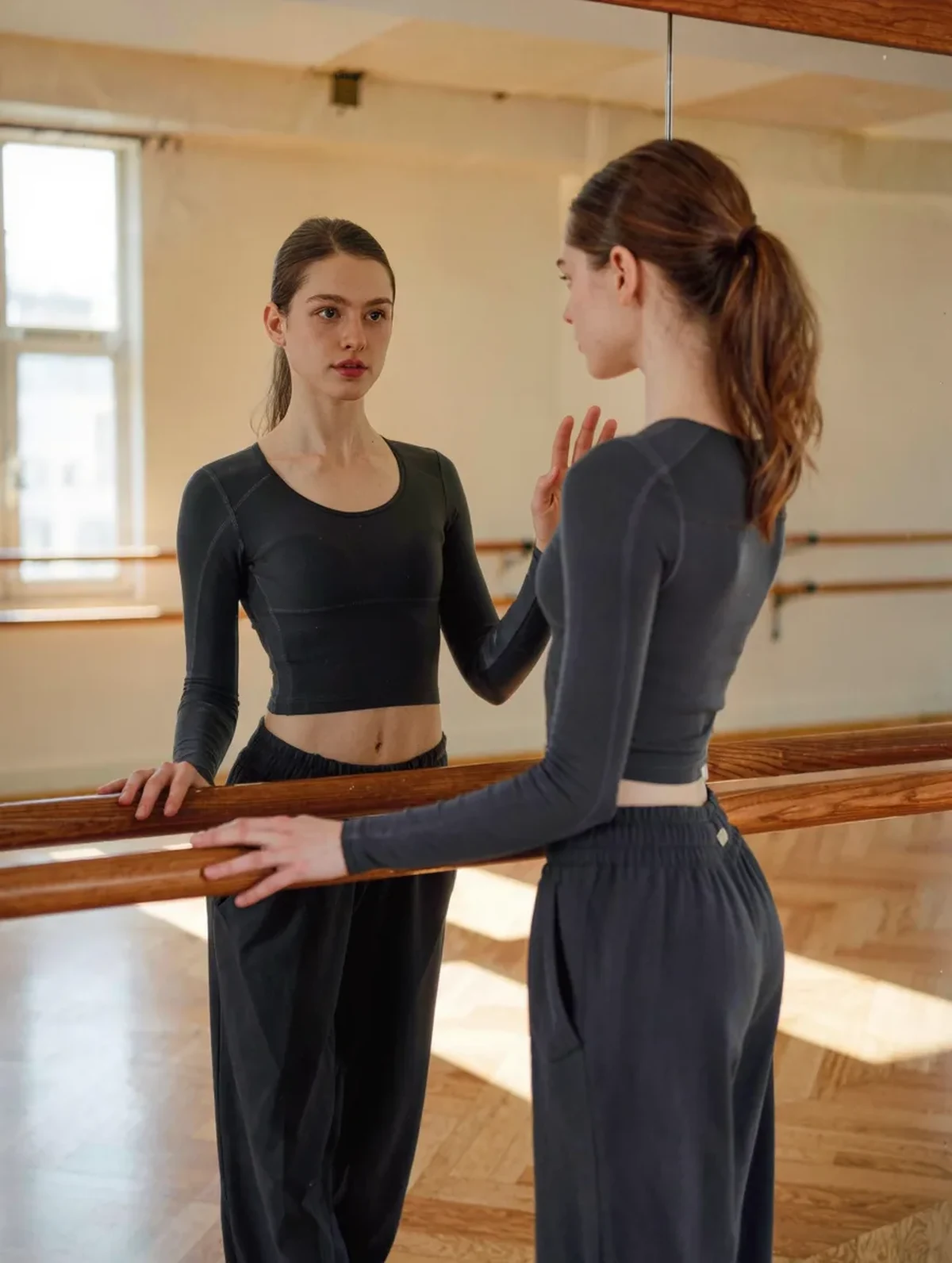
Start by choosing a fitted, moisture-wicking base layer under your bulkier top — a thin long-sleeve or fitted crop keeps the skin-contact feedback loop intact even when there’s a looser layer on top of it. This is less about temperature and more about restoring your sensor system.
Next, anchor your cues to landmarks you can still feel through fabric: your waistband pressing into your lower belly, or the seam of your leggings at your hip crease. These give you a physical reference point that doesn’t depend on skin-to-skin contact. Finally, give yourself the first two or three fall classes to consciously over-correct — exaggerate the rib-down and tailbone-tuck positions slightly more than feels necessary, since your feedback is arriving quieter than usual, not because your range needs to change permanently.
TL;DR:
- Bulky fall layers reduce skin-contact proprioceptive feedback, not your actual strength or alignment.
- Fabric slack and drape create a lag between when you move and when you feel it, dulling small cues like “ribs down.”
- Looser joggers can mask 30–40% of a normal tailbone tuck’s sensory signal by absorbing pelvic rotation into fabric instead of skin.
- A fitted base layer under bulkier outerwear preserves the feedback loop your body relies on for these cues.
Give your cues a couple of classes to recalibrate for the season — your form isn’t slipping, your sensors are just wearing a sweater too.
See It in Motion
Seen here: High Waist Yoga Leggings with Side Pockets — shop it on bubblelime.com
Keep Reading
This article is for general informational and styling purposes only. Fit, sizing, and product availability may vary.