Why Barre Makes You Shake in Muscles You Didn't Know You Had

Quick Answer: The shake in barre comes from small, deep stabilizer muscles firing rapidly under sustained low-load tension — a normal neuromuscular response called ‘the shake,’ not a sign of weakness or doing the move wrong. It typically means you’re recruiting the right small muscles the pose is designed to target.
You’re holding a small pulse at the barre and your leg starts shaking uncontrollably. Everyone in class calls it ‘the shake’ like it’s a badge of honor — but what’s actually happening in your muscle at that moment?

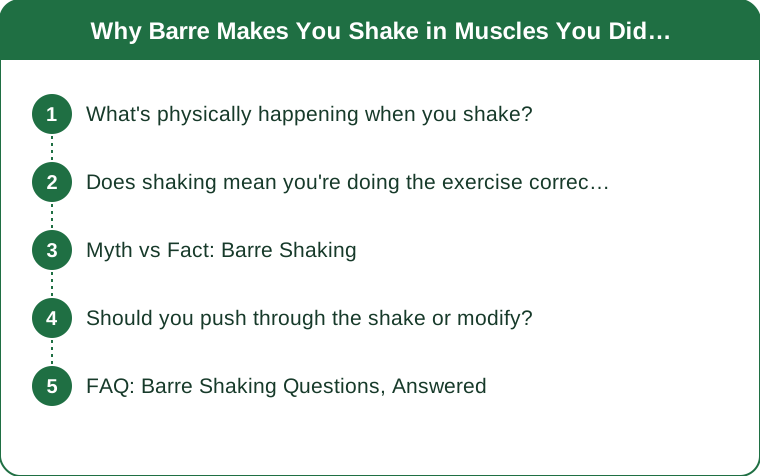
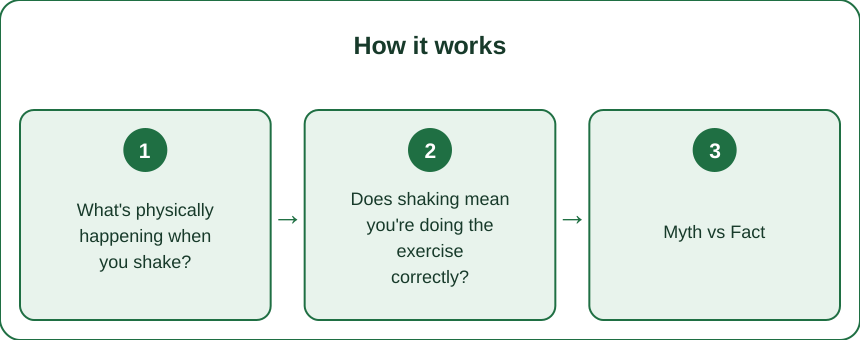
What’s physically happening when you shake?
Sustained, low-range-of-motion holds recruit small, deep stabilizer muscle fibers that fatigue faster than the larger prime-mover muscles used in bigger movements like a squat or lunge. As those small fibers hit fatigue, they start firing in rapid, uneven bursts instead of one smooth sustained contraction — that unevenness is what you feel as shaking.
It’s the same underlying mechanism as a muscle ‘burning out’ at the end of any high-rep set, just made more visible because barre’s isometric, small-range holds fatigue those specific small stabilizers faster than most other formats do.
Does shaking mean you’re doing the exercise correctly?
Generally, yes — the shake is a common sign that the deep stabilizer muscles the pose targets are actually being recruited under real fatigue, rather than the movement being cheated with momentum or a larger, less-targeted muscle group taking over.
That said, shaking that comes with sharp pain (versus a fatigue burn) or that causes you to lose control of your alignment (like your knee caving in) is a signal to modify the range or come out of the hold, not to push through.

Myth vs Fact: Barre Shaking
Myth: Shaking means you’re weak or doing barre wrong. Fact: It usually means the opposite — you’re deeply fatiguing the small stabilizer muscles the exercise is specifically designed to challenge.
Myth: The more you shake, the better the workout. Fact: A moderate shake signals good muscle recruitment; a violent shake that breaks your form or causes pain means the hold needs to be modified, not chased for its own sake.
Myth: Shaking should stop happening once you’re ‘good at barre.’ Fact: Even advanced barre practitioners shake regularly — it’s tied to the specific muscle-fatigue mechanism of small isometric holds, not a beginner-only phenomenon.
Should you push through the shake or modify?
Push through if the shake is a fatigue tremor without pain and your alignment (knee tracking, pelvis position) stays stable — this is the productive kind that builds the stabilizer strength barre targets.
Modify — reduce your range of motion, take a small break, or lower to a supported version — if the shake starts causing your form to break down or if you feel sharp joint pain rather than muscular fatigue.
FAQ: Barre Shaking Questions, Answered
Why do I shake more in some classes than others?
Fatigue level from prior workouts, hydration, and how much time has passed since your last meal all affect how quickly your stabilizer muscles fatigue and start to shake.
Is it bad if I never shake during barre?
Not necessarily — some people build stabilizer endurance faster than others, or a particular pose may not be at your current fatigue threshold yet. It’s one signal among several, not a required outcome.
Does the shake mean I’m building muscle?
It indicates real muscular fatigue and recruitment in that session, which over time contributes to strength and endurance gains — but a single shaky class isn’t a direct measure of long-term muscle growth.
TL;DR:
- The shake comes from small stabilizer muscles fatiguing and firing unevenly under sustained holds
- It generally means you’re recruiting the right muscles, not doing something wrong
- Push through a fatigue-tremor shake with stable form; modify if pain or form breakdown appears
- Even advanced practitioners shake regularly — it’s not a beginner-only sign
Next time you feel the shake starting, do a quick alignment check (knees, pelvis) rather than automatically stopping — if form holds, that’s productive fatigue.
See It in Motion
Seen here: Crewneck Short Sleeve Workout T-Shirt — shop it on bubblelime.com
Keep Reading
This article is for general informational and styling purposes only. Fit, sizing, and product availability may vary.