Why Barre Progress Shows Up Outside Class Before It Shows Up In It

Quick Answer: Barre class does not get easier as you get stronger, because the instructor scales the work to what the room can do - more range, longer holds, smaller pulses. Your improved capacity is absorbed by increased demand, so the internal experience stays roughly constant. Meanwhile the same capacity meets a fixed demand outside class - stairs, carrying, standing through a long afternoon - and there the improvement is immediately obvious. If you are judging barre progress by whether class feels easier, you are using the one metric that is designed not to move.
Three months in, you still shake in the seat work. You still cannot hold the last 30 seconds. And yet you carried the shopping up two flights last week without thinking about it, which would have been unpleasant in June.

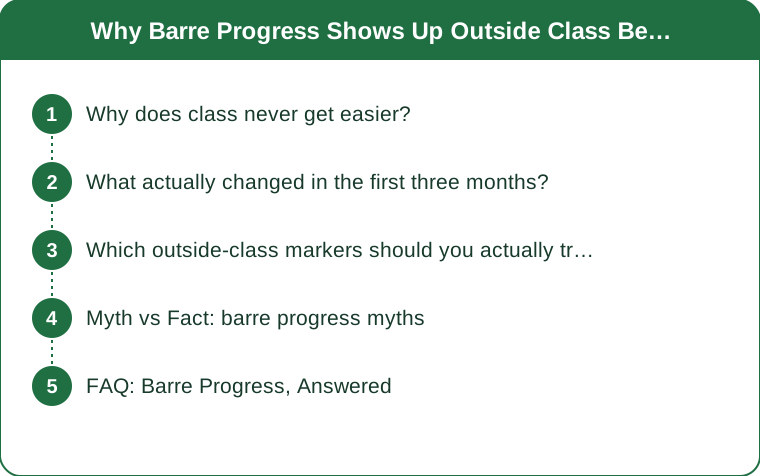
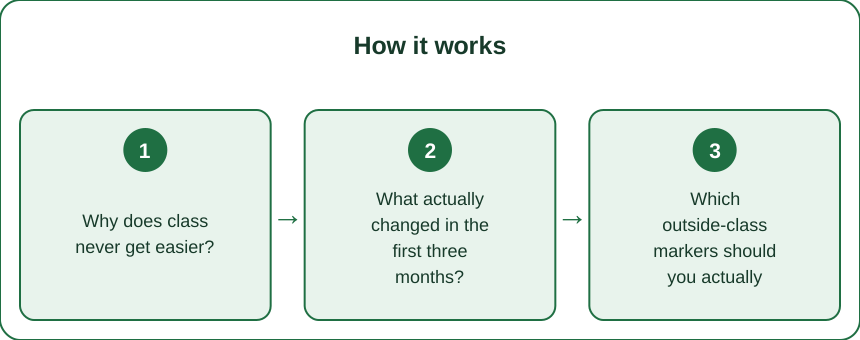
Why does class never get easier?
Because class is not a fixed test. A well-taught barre class targets a particular internal experience - the shake, the burn, the point where holding becomes negotiation. The instructor produces that experience by adjusting range, tempo, hold duration, and pulse size to what the room can currently do.
As you get stronger, those variables move. The tuck goes deeper. The pulse gets smaller and slower, which is harder rather than easier. The hold that was 45 seconds becomes 60. You are doing more work at the same subjective cost.
This is deliberate and it is good programming. A class that got easier as you improved would have stopped providing a stimulus. But it means the studio is a poor measuring instrument for your own progress, because the instrument recalibrates itself every week.
Compare it to running. A 5k is a fixed distance, so getting faster is directly visible in the time. Barre has no fixed distance. It is closer to a conversation that keeps pace with you - which is excellent for adaptation and useless for measurement.
What actually changed in the first three months?
Three things adapt fastest in barre, and only one of them is visible in class.
Isometric endurance. The ability to hold a position under tension for longer before force output drops. This is the adaptation barre trains most directly, and it improves substantially in 8 to 12 weeks. Outside class it shows up as standing through a long queue, holding a plank position while doing something else, carrying a bag on one side without shifting.
Postural endurance. The deep stabilisers around the spine and pelvis fatigue much more slowly. This is why the desk-work slump arrives an hour later than it used to, and why long car journeys stop producing the same lower back ache.
Motor control at end range. You get better at controlling positions near the limit of your range - which is what turnout work, the tuck, and the small pulses all train. Outside class this appears as fewer wobbles on uneven ground and more confidence reaching for things above shoulder height.
What does not improve much: maximal strength and power. Barre works in a narrow load range, so if your marker of progress is a heavier deadlift, it will not appear here. That is not a flaw - it is the trade the format makes.

Which outside-class markers should you actually track?
Pick two or three fixed tasks from your real life and check them monthly. They need to be genuinely fixed - the same stairs, the same bag, the same duration - or they inherit the same recalibration problem as class.
Good candidates:
- A specific flight of stairs. Note whether you arrive at the top breathing hard, and whether you hold the rail. Both change noticeably in three months.
- Standing duration before shifting weight. Time how long you can stand still - washing up, waiting - before you unconsciously shift onto one hip. This one moves a lot and almost nobody tracks it.
- Getting up from the floor without hands. A single clean rep is a genuine milestone if you could not do it before.
- Carrying groceries in one hand. Note the distance before the shoulder drops or you have to swap.
Check monthly, not weekly. These markers move on a timescale of weeks and weekly checking produces noise that reads as no progress.
Write the starting values down. The most common reason people miss their own progress is that the new normal overwrites the memory of the old one within about a fortnight.
Myth vs Fact: barre progress myths
Myth: If class still feels hard, you are not improving. Fact: Class is scaled to your current capacity, so it should always feel hard. Difficulty is constant by design; capacity is what changed.
Myth: The shake means you are getting stronger. Fact: The shake is a motor recruitment phenomenon at sustained low-load tension. Beginners shake and advanced students shake. It signals that you are in the target zone, not that you are progressing.
Myth: Barre plateaus after three months. Fact: What plateaus is the visible novelty. Adaptation continues, and the endurance and control gains keep accumulating for a long time. The apparent plateau is usually a measurement problem rather than a physiological one.
Myth: You need to add weights to keep progressing. Fact: Range, tempo, hold duration, and reduced support are all progression variables, and most are more relevant to what barre trains than load is. Heavier hand weights are the least useful of the available levers.
Myth: If you are not sore, the class was too easy. Fact: Soreness tracks novelty far more closely than it tracks effectiveness. Your fifteenth class should produce less soreness than your first while producing more adaptation.
FAQ: Barre Progress, Answered
How long before I should expect to notice something outside class?
Most people notice the first fixed-task change between weeks five and eight - usually stairs or standing duration. Postural changes at a desk tend to arrive slightly later, around week ten.
Should I take a harder class to keep progressing?
Only if your current class is genuinely not producing the shake or the burn any more. Most people do better staying in a well-taught class and reducing their support - hand off the barre, deeper range - than moving to a level that forces them to compensate.
Is it a problem that barre does not build maximal strength?
Only if maximal strength is your goal. If it is, pair two barre classes a week with one session of heavier compound lifting. They complement each other well and the barre work makes the lifting positions easier to hold.
TL;DR:
- Class never gets easier because the instructor scales demand to your capacity - the difficulty is held constant by design.
- The real adaptations are isometric endurance, postural endurance, and end-range control, and all three show up first in daily life.
- Track two or three genuinely fixed tasks - a specific flight of stairs, standing duration, carrying distance - monthly rather than weekly.
- Write down your starting values, because the new normal overwrites the old one within a fortnight.
- The shake is a zone indicator, not a progress indicator.
If class still feels hard three months in, that is the format working. Go and check the stairs instead.
See It in Motion
Seen here: High Waist Yoga Leggings with Side Pockets — shop it on bubblelime.com
Keep Reading
This article is for general informational and styling purposes only. Fit, sizing, and product availability may vary.