Why Barre Stops Working Around Month Three (and How to Restart Progress)

Quick Answer: Barre plateaus around week 10-14 because the format’s small isometric holds create fast neuromuscular gains that max out once your nervous system has learned the movements. The fix is not more classes - it is adding external load, slowing tempo, and rotating class formats every four weeks so the stimulus keeps changing.
You went from shaking through the first thigh section to holding it comfortably. That felt like progress, and it was. Then somewhere around the third month, everything got easier and nothing got better. That is not you losing dedication. It is a predictable feature of how barre loads the body.

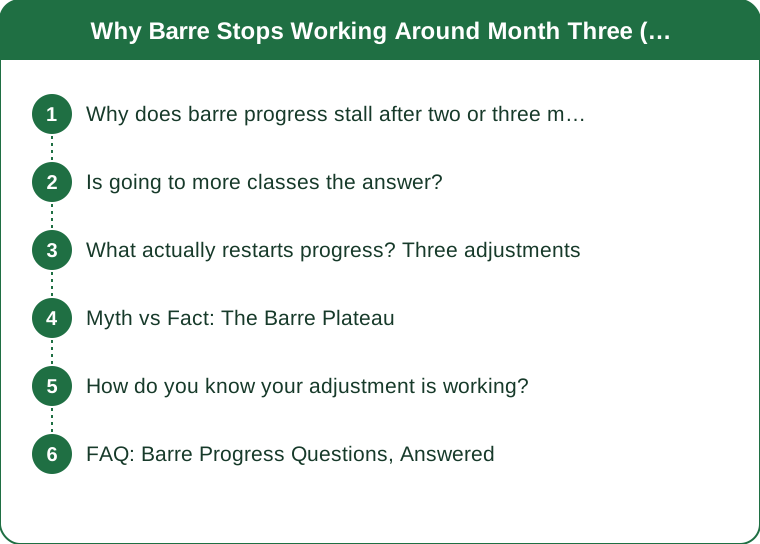
Why does barre progress stall after two or three months?
The first phase of barre improvement is mostly neuromuscular, not muscular.
When you start, your nervous system does not yet know how to recruit the small stabilising muscles the format demands - the deep hip rotators, the transverse abdominis, the muscles around the shoulder blade. Early gains come from learning to fire them efficiently, and that learning curve is steep and fast.
That curve flattens. Once your nervous system has the pattern, additional improvement has to come from the muscle actually getting stronger or the tissue getting more capable. That requires progressive overload - meaning the demand has to keep increasing.
Here is barre’s structural limitation: a one-inch pulse against gravity with a two-pound weight is a fixed load. You cannot pulse harder. Once you can complete the sequence without shaking, the class is no longer near your limit, and a stimulus that is not near your limit does not drive adaptation.
The shaking is the clue. Most people treat the shake as the point of barre. It is actually a signal of local muscular fatigue at a load you are not yet adapted to. When it stops, the load has stopped being challenging - which is exactly when people report the plateau.
Is going to more classes the answer?
Usually not, and this is where most people spend their effort for no return.
Going from three classes a week to five adds volume, not intensity. If the load is below your adaptation threshold, doing more of it mostly adds fatigue. You will feel busier and progress at the same rate.
Frequency helps in one specific case: if you are currently doing one or two classes a week, going to three does add meaningful stimulus. Below about twice weekly, most people are under-stimulated rather than plateaued.
Above three classes a week, the returns drop sharply unless something else changes. The extra sessions become skill maintenance rather than progression.
What the extra class costs you: recovery capacity and time you could spend on a genuinely different stimulus. Two barre classes plus one heavier strength session will outperform four barre classes for almost anyone who has been at it three months.
The honest test: if you have added classes in the last month and feel more tired without feeling stronger, you have your answer.
What actually restarts progress? Three adjustments
1. Add external load - and more than you think.
The standard two- or three-pound barre weight is appropriate for a beginner learning shoulder positioning. It stops being a training stimulus quickly. Move to five pounds for arm sections, then eight. Most studios have them; most people never pick them up.
For lower body, a long resistance band or a mini band above the knee during glute and thigh sections restores the shake immediately. This is the fastest single change you can make.
2. Slow the tempo down.
If the class does eight pulses, do four at double the duration. Time under tension is the variable barre can actually manipulate, and a 4-second lowering phase with a 2-second hold is dramatically harder than a fast pulse at the same position.
This one is free, requires no equipment, and can be done in any class without disrupting anyone.
3. Rotate formats every four weeks.
Barre studios usually offer variations - cardio barre, barre with sliders, barre fusion with mat work, longer-hold formats. Staying in one format for six months means the same muscles get the same stimulus in the same sequence.
Four weeks is roughly the useful lifespan of a specific class format before the novelty stops producing adaptation. Rotating does not mean abandoning barre - it means keeping the stimulus unfamiliar enough to matter.

Myth vs Fact: The Barre Plateau
Myth: If you’re not shaking, you’re not working. Fact: Shaking indicates local fatigue at an unfamiliar load. It is a useful signal early on and an unreliable one later - experienced practitioners can work hard without shaking and shake on a genuinely easy day if they are tired or under-fuelled.
Myth: Barre alone builds all the strength you need. Fact: Barre is excellent for endurance in small stabilising muscles and body awareness. It is poor at building maximal strength or loading the posterior chain heavily, which is why pairing it with one or two proper strength sessions works so well.
Myth: A plateau means you should switch to something else entirely. Fact: Plateaus are a sign the stimulus needs to change, not that the method failed. Most people who quit at month three would have progressed for another year with three small adjustments.
Myth: Long, lean muscle is a thing barre creates and weights destroy. Fact: Muscle length is determined by where the tendons attach, which is genetics. What changes with training is muscle size and body composition. Nobody has ever lengthened a muscle by pulsing.
Myth: More classes per week is always better. Fact: Above roughly three sessions weekly, additional barre volume adds fatigue faster than it adds adaptation for most people.
How do you know your adjustment is working?
Give any change four weeks before judging it, and track something specific rather than relying on how sessions feel.
Useful markers:
- How long you can hold a single-leg glute bridge before form breaks - test it monthly, same time of day
- Whether the shake returns in thigh work at the new load
- Push-up count to failure, if your classes include them
- How your hips feel at the end of a long desk day
Why feel is unreliable: as you get fitter, hard sessions feel more manageable, so the sensation of effort drops even as capacity rises. If your only measure is whether class felt tough, you will systematically under-rate your progress.
What a good four weeks looks like: the first two sessions at the new load feel notably harder, sessions three through six feel manageable, and by week four you need the next increment. That cycle repeating is what progression actually looks like.
Late summer note: studios are quieter in August, which makes it an easy month to ask an instructor for form checks on the loaded variations before autumn classes fill up. Most are happy to; almost nobody asks.
FAQ: Barre Progress Questions, Answered
How long should I stay at a given weight before increasing?
When you can complete every rep of an arm section with clean form and no last-set struggle, it is time to go up. For most people that is three to four weeks per increment early on.
Will heavier weights make barre feel less like barre?
The format stays the same - the same holds, the same tempo, the same sequences. What changes is that the last third of each section becomes hard again, which is what most people miss when they plateau.
Can I fix a plateau without adding equipment?
Yes, with tempo. Halving the rep count and doubling the duration of each phase is the free version, and it works. Equipment is faster but not required.
Should I take a full week off?
A deload week - reduced volume rather than complete rest - is worth trying if you have been consistent for three months and feel flat rather than merely unchallenged. Persistent fatigue, poor sleep, and declining performance together are worth discussing with a professional. This is general information, not medical advice.
TL;DR:
- Barre’s fast early gains are mostly neuromuscular learning, and that curve flattens around week 10-14
- More classes adds fatigue, not stimulus, once you are above about three a week
- Three fixes: heavier external load, slower tempo with fewer reps, and rotating class format every four weeks
- Track a specific marker monthly - feel becomes unreliable as you get fitter
- The shake is a load signal, not a goal, and its absence is the plateau’s clearest tell
August is a quiet month at most studios, which makes it the easiest time to get an instructor to check your form on the loaded variations.
See It in Motion
Seen here: High Waist 8” Yoga Shorts — shop similar styles on bubblelime.com
Keep Reading
This article is for general informational and styling purposes only. Fit, sizing, and product availability may vary.