Why Barre Feels Easier the Week You Finally Get Stronger - and Why That Is a Problem

Quick Answer: Barre plateaus quickly because the load is fixed at your bodyweight and the reps are already high, which leaves almost no room to progress once you adapt. When the shake fades, that is adaptation, not mastery. To keep progressing you have to add an external variable - tempo, range, load, or a strength session - because the class itself cannot get heavier.
Around the eight to twelve week mark, most regular barre attendees notice the same thing: the class stops being hard. The instinct is to add more classes. That is usually the wrong lever.

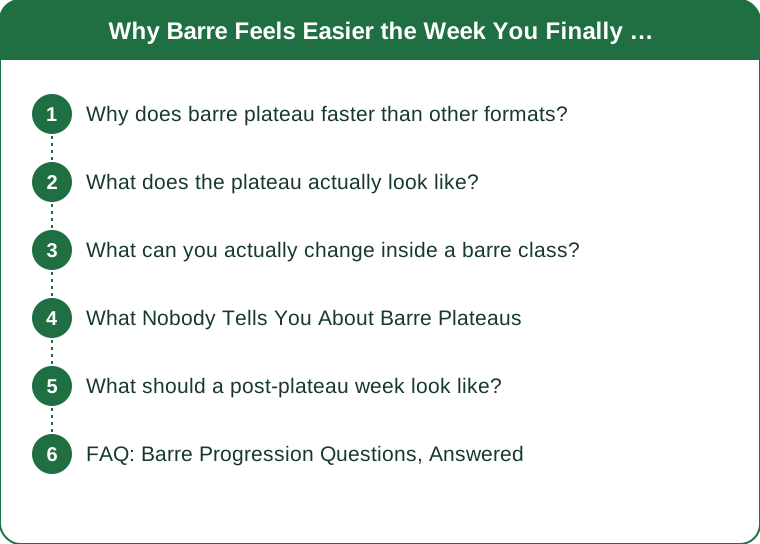
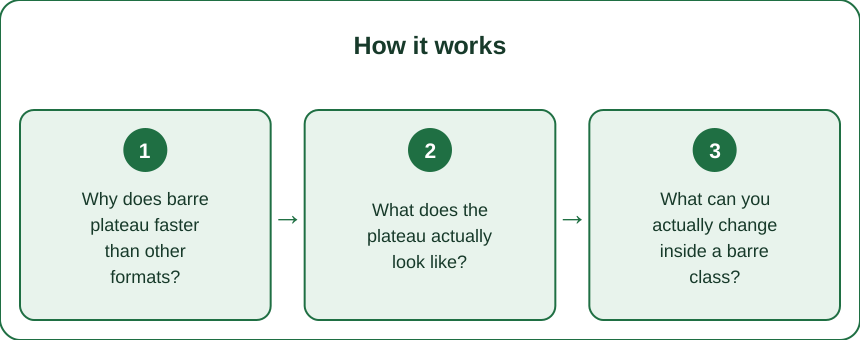
Why does barre plateau faster than other formats?
Because it starts near the top of its own progression.
Strength training progresses by adding weight. Running progresses by adding distance or speed. Barre progresses by… doing the same class again, and that is the structural problem.
Three things cap the ceiling:
- The load is your bodyweight, and it does not change. A one-pound weight and a resistance band are not meaningful progression tools once you have adapted to them
- The rep ranges are already very high. Sixty small pulses is already deep into muscular endurance territory. There is nowhere higher to go that means anything
- The movement patterns repeat. Most classes follow a near-identical structure, so the novelty stimulus disappears fast
What that means physiologically: you get a genuine and often rapid improvement in muscular endurance and positional control in the first two to three months. Then the stimulus stops exceeding your capacity, and adaptation stops with it.
The shake is the clearest signal. Early on, the shake is your nervous system struggling to hold a sustained low-load contraction. As you adapt, the shake reduces because you have got better at exactly that. It is a progress marker that disappears when you make progress - which makes it a terrible thing to chase and a very good thing to notice.
What does the plateau actually look like?
Four signs, and most people notice at least two before they name what is happening.
The shake goes. Thigh work that used to be genuinely difficult at minute two now feels like a warm-up. This is the earliest and clearest signal.
Class stops leaving a mark. No soreness the next day, ever, no matter how many classes you take. Some of that is a good thing. All of it is a plateau.
Your body composition stops changing despite unchanged effort and diet. This is usually the one that prompts people to look for answers.
You can chat through it. Not literally, but the sense of full absorption in getting through a set is gone.
Timeline: for someone starting from little training, this typically arrives around week 10 to 16 of consistent attendance. For someone with a strength background, it can come as early as week four.
The wrong response, and it is nearly universal: adding more classes. Going from three to five sessions a week increases fatigue and time cost without increasing the stimulus, because the limiting factor is intensity, not volume. Five easy classes is not harder than three easy classes in any way that produces adaptation.
What needs to change is what one class asks of you.
What can you actually change inside a barre class?
Four variables, in rough order of how much they cost you to implement.
1. Tempo - free, immediate, effective. Take the tempo the instructor calls and halve it on the eccentric. In a plie sequence, lower over four counts instead of two. Time under tension is the most accessible progression variable in a bodyweight format and it changes a set dramatically.
2. Range - free, and most people are quietly cheating it. Full depth on every plie, full extension on every leg lift, all the way down on every push-up. The range shortens invisibly as fatigue arrives, and reclaiming it makes the same class meaningfully harder.
3. Load - cheap. Bring 3lb or 5lb weights instead of the studio’s 1lb set, and put a proper resistance band around your thighs for glute work. Studio weights are sized for a beginner in week one. If you have been going for four months, you are not that person.
4. Position - free. Take the harder variation every time it is offered. Heels higher, hands off the barre, single leg instead of double. Most classes offer a progression and most regulars quietly take the middle one.
5. Isometric holds. Where the class pulses, hold. Where the class holds, hold longer. A 45-second hold at full depth is a different exercise from 45 seconds of pulses.
Try one at a time for two weeks so you can tell which one your body actually responds to. Changing everything at once tells you nothing.

What Nobody Tells You About Barre Plateaus
The shake was never the point. It is a fatigue signal in a small stabilising muscle, not a measure of how much work you did. A heavy set of five squats produces no shake and far more adaptation.
Barre is very good at what it is good at. Positional endurance, hip and glute control, posture, ankle and foot strength, and the ability to hold a difficult shape. Those are real, useful, and undervalued. It is simply not built to keep building maximum strength, and asking it to is the source of most of the disappointment.
Instructors know. Most experienced barre teachers will happily tell you to add heavier weights or lift outside class if you ask directly. The class is written for a mixed room, and the mixed room includes a lot of week-one attendees.
The people you see who look strongest in the room are usually doing something else too. This is not a secret so much as something nobody mentions. Two barre classes plus two strength sessions is a far more effective week than four barre classes.
Plateauing is not failure - it is the intended endpoint of the adaptation. Your body did exactly what you asked. The question is only what you ask next.
And the honest one: if you love the class, go to the class. A format you attend for years beats an optimal programme you quit in March. Just be clear with yourself about which goal you are serving.
What should a post-plateau week look like?
Keep the barre. Add the thing barre cannot do.
The template: two barre classes, two strength sessions, one walk or easy cardio day.
The strength sessions do not need a gym, though a gym makes it easier. Each session, roughly 35 minutes:
- A squat pattern: goblet squat or split squat, 3 sets of 8-10, heavy enough that the last two reps are genuinely hard
- A hinge pattern: Romanian deadlift or single-leg deadlift, 3 sets of 8
- A push: push-up or dumbbell press, 3 sets of 8
- A pull: row of any kind, 3 sets of 10
- One carry or core piece: suitcase carry 3 x 30 seconds each side
The key difference from barre: 8-10 reps with real load, not 60 reps with none. That is the part of the strength curve barre never touches.
What to expect: most people notice their barre classes get easier again within four to six weeks, because they are now stronger than the class demands. That is the correct outcome, and it means the strength work is doing its job.
Do not drop barre to do this. The positional control and endurance you built there is genuinely useful and it degrades if you stop. Two classes a week maintains it comfortably.
If you have a joint issue, are pregnant or postpartum, or are returning from injury, get the strength progression checked by a physiotherapist first - loading patterns need adjusting in all three cases. This is general information, not medical advice.
FAQ: Barre Progression Questions, Answered
Is barre a waste of time if it plateaus?
No. It builds real muscular endurance, hip control, and posture, and it maintains them well. It just is not a complete programme past the first few months, which is a different criticism.
How heavy should the weights be?
Heavy enough that you could not do another ten reps at the end of a set. For most regular attendees that means 5-8lb rather than the 1-3lb sets most studios provide.
Will lifting make barre harder or easier?
Easier, quickly. That is the point - you want the class to sit comfortably inside your capacity rather than defining it.
How many barre classes a week is worth it?
Two to three, paired with something that loads you heavily. Beyond three, you are adding time and fatigue without adding stimulus.
TL;DR:
- Barre plateaus fast because bodyweight load is fixed and the reps are already very high
- The shake fading is an adaptation signal, not a sign you are doing it wrong
- Adding more classes does not fix an intensity problem - change tempo, range, load, or position instead
- Bring your own 5lb weights and a real band; studio equipment is sized for week one
- Two barre classes plus two heavy strength sessions beats four barre classes
The class did exactly what it was designed to do, and then it ran out of road. Keep it for what it is genuinely good at, and put the progression somewhere the load can actually go up.
See It in Motion
Seen here: Bootcut Capri Yoga Pants with Pockets — shop similar styles on bubblelime.com
Keep Reading
This article is for general informational and styling purposes only. Fit, sizing, and product availability may vary.