What Actually Changes When You Move Barre From Evening to Morning

Quick Answer: Morning bodies are stiffer, cooler and lower in core temperature, which makes barre feel about 20 percent harder for the first three weeks. Longer warm-ups, smaller initial range, and eating something before class close most of the gap, and the adaptation is real rather than permanent.
The 6.30pm class you have taken for two years now collides with school pickup, and the only slot that works is 7am.
First morning, your plies feel shallow, your seat work shakes at half the usual point, and you leave wondering if you have lost a season of progress in a week. You have not. You are training a different body at a different point in its daily cycle.

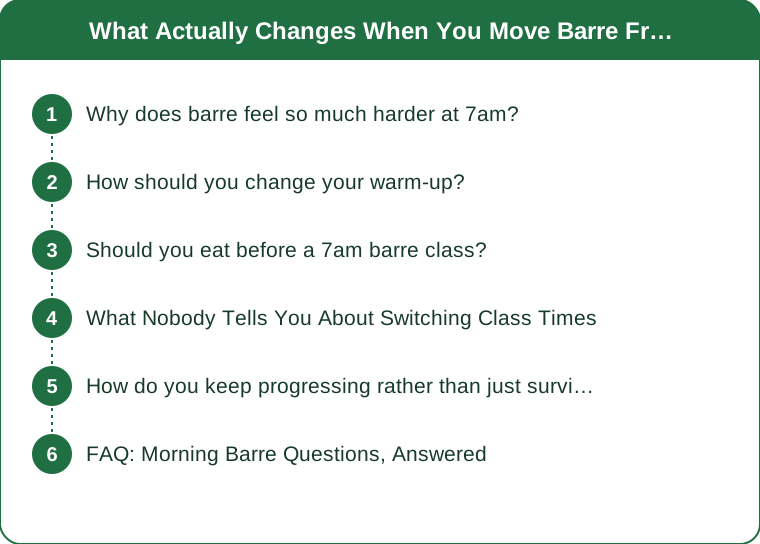
Why does barre feel so much harder at 7am?
Four measurable things are different, and barre happens to be sensitive to all of them.
Core temperature is at its daily low in the early morning, typically a degree or so below its late-afternoon peak. Muscle is more compliant when warm, which is why the same plie depth feels available in the evening and not at dawn.
Spinal discs are hydrated overnight, which is why you are slightly taller in the morning and why your spine has less flexion range for the first hour or two after waking. Barre’s tuck and curl work sits right in that range.
Tissue viscosity is higher. Joints move against more internal resistance early on, which makes small controlled pulses, the entire premise of barre, feel heavier than they will at 6pm.
And you have not eaten. Muscle glycogen after an overnight fast is lower, and barre’s long time-under-tension sets are metabolically demanding in a way people underestimate.
None of these mean morning training is worse. They mean the same class is a different stimulus, and that first class should be adjusted rather than powered through.
How should you change your warm-up?
Double it, and change its character. An evening warm-up is a formality because you have been walking, sitting, standing and moving for ten hours. A morning warm-up is doing genuine work.
Arrive ten minutes early and do this before the class starts:
- Two minutes of walking or marching in place, enough to raise your temperature slightly.
- Ten cat-cows, slowly, to bring your spine gradually into flexion rather than dropping into a deep tuck cold.
- Twenty ankle circles each direction. Barre lives on releve, and morning ankles are noticeably stiffer.
- Ten bodyweight squats to about half depth, then ten more slightly deeper.
- Ten arm circles each way and ten shoulder rolls.
Then, in the class itself, treat the first third as extended warm-up rather than as work. Take smaller range, lighter or no weights in the first arm sequence, and shallower plies. You are not going easy; you are sequencing the session so that your hardest efforts land after your body is actually online, which is 15 to 20 minutes in rather than at minute two.
Should you eat before a 7am barre class?
For most people, something small, yes. Barre is not a gentle stretch class. A 50-minute class with sustained isometric holds and high-repetition seat and thigh work draws meaningfully on glycogen, and the shaking that arrives too early in a fasted morning session is often fuel-related rather than strength-related.
What works: a banana, a slice of toast with honey, a small yoghurt, or half an energy bar, 30 to 45 minutes before. Roughly 20 to 30 grams of easily digested carbohydrate. Enough water to not start dehydrated, since you lose fluid overnight.
What does not: a full breakfast 15 minutes before, which sits heavily through the core work and the inversion-adjacent positions. Or coffee alone, which will make you feel alert without providing anything for your muscles to use.
Some people genuinely prefer fasted morning training and feel fine. If that is you, keep it, but stay alert for the specific signs it is not working: shaking that starts in the first ten minutes, unusual lightheadedness in releve, or a persistent crash mid-morning afterwards.

What Nobody Tells You About Switching Class Times
Your three-week judgment will be wrong. Circadian adaptation to a new training time takes roughly two to four weeks. If you evaluate morning barre after two sessions you will conclude you got worse. Give it a month before deciding anything.
Your consistency will probably improve. This is the honest reason most people end up staying. Morning classes get missed far less often because nothing has happened yet to derail your day. A slightly harder class you attend four times a week beats a better class you attend twice.
Your sleep will need to move too. You cannot simply subtract 90 minutes from the front of your night and expect the same output. The bedtime has to move with the alarm, and that is the part people skip.
The first ten minutes lie to you. How you feel at minute five in a morning class predicts almost nothing about minute thirty. Many people who feel dreadful warming up have a genuinely strong session once temperature rises.
And the detail that catches everyone: you will be slightly taller and less flexible in forward folds first thing, because of overnight disc hydration. If your instructor cues a deep forward fold in the first five minutes, take it to half depth without guilt. That is not tightness, it is anatomy on a schedule.
How do you keep progressing rather than just surviving?
Reset your reference points, because comparing a morning class to your evening peak will make everything look like regression.
Rebaseline for two weeks. Note where your shaking begins, how deep your plie is, and how many reps you complete at full range. Those are your new starting numbers. Progress from those.
Stack the hard work later in class. If your studio offers any flexibility, put heavier arm work and the most demanding seat sequences after the halfway mark. Save maximal range for the back half.
Keep one evening class a week if you can. It gives you a warmer, higher-output session for testing range and adding load, while the morning classes deliver consistency and volume. Many people find this combination better than either alone.
Warm the room, or yourself. A hot shower before leaving genuinely helps. So do layers you keep on for the first ten minutes rather than stripping down at the door.
Expect the gap to close by week four. Morning performance rises toward evening levels as your body adapts to the new schedule. The difference never disappears entirely, but it shrinks from obvious to marginal.
FAQ: Morning Barre Questions, Answered
Is morning exercise less effective than evening exercise?
For strength and power output, late afternoon is a genuine peak for most people, with differences in the region of a few percent. For consistency, habit formation and adherence, morning wins decisively for most schedules. Since the training you actually do beats the training that is theoretically optimal, morning barre four times a week outperforms evening barre twice a week by a wide margin.
Why am I more prone to injury in the morning?
The risk is modest rather than dramatic, and it comes from cold tissue and reduced spinal flexion tolerance rather than anything mysterious. Nearly all of it is managed by a longer warm-up and by taking smaller range in the first third of class. The specific things to be careful with are deep forward folds, aggressive tucks and end-range stretching in the opening minutes.
How long until morning classes stop feeling awful?
Most people report a clear turn at two to three weeks and feel settled by four to six, provided the bedtime moved along with the wake time. If you are still dreading it and underperforming after six weeks of consistent attendance and adequate sleep, that is useful information rather than a failure, and an early evening or lunchtime slot may simply suit you better.
TL;DR:
- Morning bodies are cooler, stiffer and lower on fuel, so the same class genuinely feels harder for the first few weeks.
- Double your warm-up, treat the first third of class as extended preparation, and take smaller range early.
- Eat 20 to 30 grams of easy carbohydrate 30 to 45 minutes before, unless fasted training clearly suits you.
- Rebaseline your reference points, move your bedtime with your alarm, and judge the switch at four weeks rather than two.
The trade you are making is a small amount of peak output for a large amount of consistency, and over an autumn term that trade almost always comes out ahead. Give it a month, adjust the warm-up rather than your expectations of yourself, and the 7am class stops being the compromise version.
See It in Motion
Seen here: High Waist Printed Bootcut Yoga Pants with Pockets — shop it on bubblelime.com
Keep Reading
This article is for general informational and styling purposes only. Fit, sizing, and product availability may vary.