How to Progress a Barre Workout Without Adding Weight

Quick Answer: Barre progression usually comes from range of motion, tempo, and pulse count, not heavier weights — shrinking your pulses to a smaller, slower range at the same 1-2 lb weight is often harder than simply going heavier.
You’ve been doing barre for months and the 2 lb weights haven’t changed, so it’s easy to assume you’ve plateaued. Most barre instructors design the format around micro-adjustments, not load increases, and those adjustments are where the real progress happens.

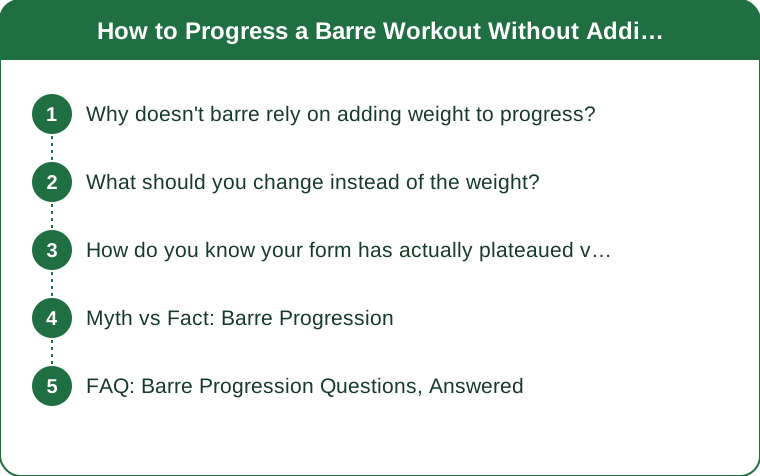
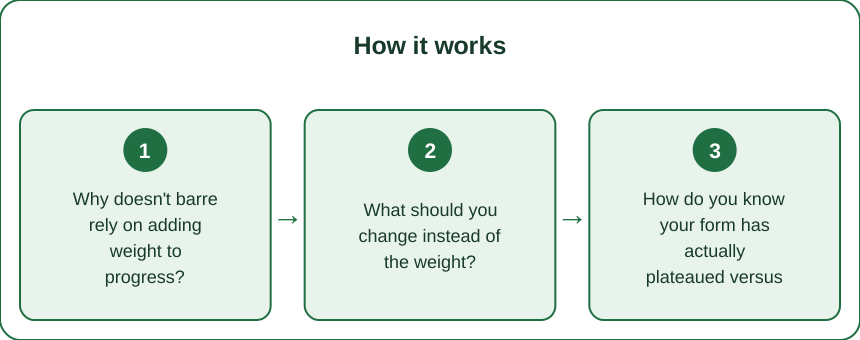
Why doesn’t barre rely on adding weight to progress?
Barre technique is built around isometric holds and small-range pulses that target muscle endurance and control rather than maximal strength, which is what heavier weight training is optimized for. Going much heavier actually works against the format — it encourages momentum and larger movements, which defeats the small-range control barre is designed to build.
What should you change instead of the weight?
Slow your tempo down first — a pulse that takes 2 full seconds instead of 1 recruits the target muscle for longer under tension. Shrink your range of motion once form feels easy, since a smaller, controlled pulse at the top of a lift is often harder than a bigger, looser one. Add a hold at the hardest point of a sequence for 8-10 seconds before resuming pulses.

How do you know your form has actually plateaued versus just feeling easy?
Check whether you can hold the position with visibly shaking muscles — that shake is a normal sign of muscular fatigue in barre-style isometric work, not a bad sign. If a sequence stopped producing any shake or burn at all, that’s the real signal it’s time to shrink the range or slow the tempo, not necessarily add weight.
Myth vs Fact: Barre Progression
Myth: heavier weights mean better barre results. Fact: most barre-specific strength gains come from time under tension and range control, and adding significant weight can actually shift the exercise into a different movement pattern that no longer trains the same way.
Myth: barre burn means you’re doing it wrong. Fact: the shake and burn in the final pulses of a set is the intended muscular fatigue response the format is built to create.
FAQ: Barre Progression Questions, Answered
Should I ever increase my barre weights at all?
A modest increase (1 lb to 2 lb, for example) is fine occasionally, but it’s a smaller lever than tempo and range changes for most people.
How often should I change up my barre routine to keep progressing?
Revisiting your tempo and range every 3-4 weeks tends to keep progress moving without needing new equipment.
Is it normal for barre to feel harder in a smaller range of motion?
Yes — a smaller range at the top of a lift, where the muscle is already shortened, is often the hardest part of the movement.
TL;DR:
- Barre progress usually comes from tempo, range, and pulse count, not heavier weights
- Slowing tempo and shrinking range increases difficulty at the same weight
- Muscle shake in the final pulses is the intended fatigue response, not a mistake
- Revisit tempo and range every 3-4 weeks to keep the workout challenging
See It in Motion
Seen here: High Waist Yoga Leggings with Inner Pocket — shop it on bubblelime.com
Keep Reading
This article is for general informational and styling purposes only. Fit, sizing, and product availability may vary.