How to Tell a Good Barre Class From a Bad One in the First Ten Minutes

Quick Answer: A good barre class corrects your alignment by name, progresses over the hour rather than shuffling exercises randomly, uses the barre for balance rather than for hanging, and gives you enough time in each position to reach genuine fatigue. A weak class runs on cueing volume and shake-for-its-own-sake. You can read most of this within ten minutes of the warm-up.
The shake is not the point. Plenty of badly run classes produce shaking, and shaking is a poor proxy for a training effect.

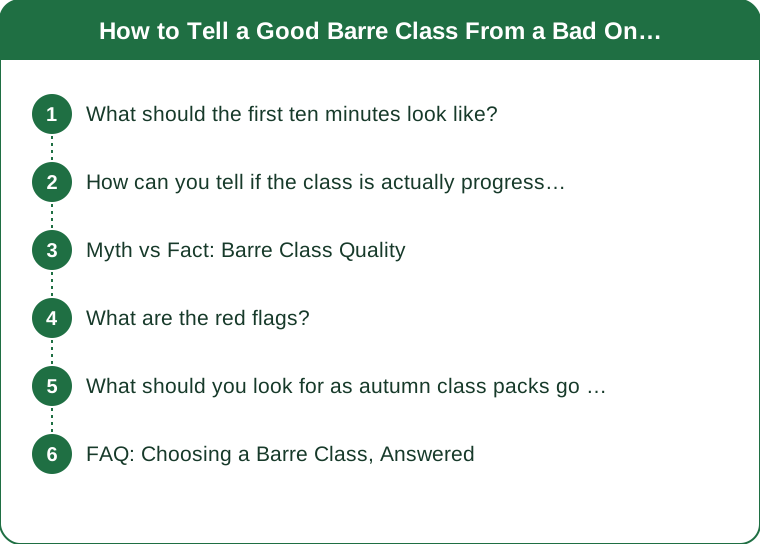
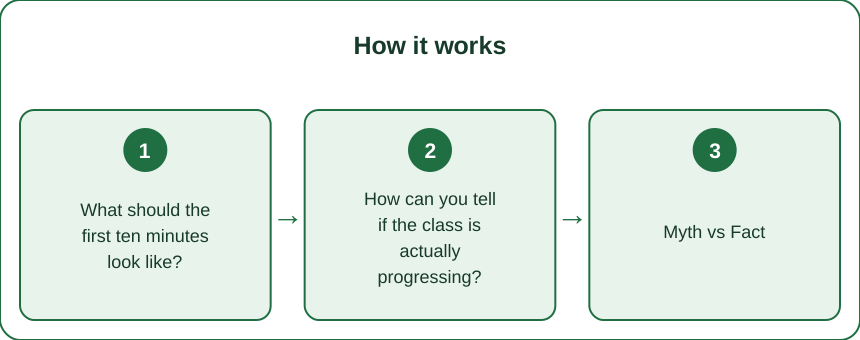
What should the first ten minutes look like?
Structured, specific, and personal - not just a faster version of the class.
A good warm-up prepares the joints you are about to load. Barre loads the hips, ankles, and shoulders in small ranges under long tension, so the warm-up should mobilise those. Ankle work, hip circles, spinal articulation, shoulder rolls. If the warm-up is just a faster set of the same exercises, that is a signal.
The instructor should have looked at you before you start moving. A good instructor scans the room in the first two minutes, notices who is new, and asks about injuries and pregnancy. A class that starts with the music and never checks the room is a class where nobody is going to correct your alignment either.
Cues should include a why. “Tuck your pelvis” is a position. “Draw your ribs down so your lower back is not doing the work” is a position plus a reason, and the reason is what lets you self-correct on rep 40 when nobody is watching.
Watch how they handle a beginner. Offering a regression before anyone struggles is the sign of a well-taught class. Waiting until someone visibly fails is not.
How can you tell if the class is actually progressing?
A good hour has a shape. A weak one is a playlist.
The shape that works: warm-up, then large muscle groups while you are fresh - thighs and glutes - then the smaller and more technical work, then core, then stretch. Loading small stabilisers first means the big work later is limited by fatigue in the wrong muscle, which is a common structural fault in poorly planned classes.
Within each section there should be progression too. A thigh section might run: position held static, then small pulses, then a wider range, then a hold to finish. That is a deliberate build. Jumping between unrelated exercises every 45 seconds is entertainment, not training.
Time under tension should be long enough to matter. Barre works through sustained low-load contraction, and that needs 45 to 90 seconds in a position to do much. Sections that end at 20 seconds because the track changed are being run by the music rather than by the plan.
Look for repetition week to week. Good barre programmes repeat exercises so you can measurably improve at them. A studio that boasts every class is completely different is telling you there is no progression - you will be permanently a beginner at everything.
Myth vs Fact: Barre Class Quality
Myth: The more you shake, the better the class. Fact: Shaking is neuromuscular fatigue in a sustained isometric hold. It appears reliably in a well-run class, but it also appears when you are simply badly positioned, dehydrated, or holding a position your stabilisers cannot support yet. It is a side effect, not a target.
Myth: A good instructor never lets you rest. Fact: Brief resets between sections improve the quality of the next block. An instructor who never permits a rest is prioritising the sensation of intensity over the actual work.
Myth: Barre is low impact so form matters less. Fact: Low load and high repetition is exactly the situation where small alignment errors accumulate. A hundred reps in a slightly collapsed position is a hundred reps of loading a joint at a bad angle.
Myth: If you are not sore the next day it was a waste. Fact: Soreness tracks novelty far more than effectiveness. Your first class will be sore; your fortieth may not be, and the fortieth is probably the more productive session.
Myth: You need to hold the barre tightly for stability. Fact: This is the most common technical fault in the room. The barre is a light balance reference, not a support. Gripping it transfers load out of the working leg and into your arms and shoulders, which is precisely the load you came to place elsewhere. A good instructor calls this out constantly - fingertips only.

What are the red flags?
Some are about safety, some about value. The safety ones matter more.
Safety red flags:
- No injury or pregnancy check at any point before or during class.
- Deep repeated end-range spinal flexion under load, especially fast crunching for large numbers of reps.
- Ballistic bouncing at end of range in stretches, rather than controlled holds.
- No regression offered for anyone visibly struggling.
- An instructor who never leaves the front of the room. If they cannot see you from the side, they cannot see your alignment.
Value red flags:
- Every class is completely different, with no repeated exercises to improve at.
- The music drives the timing rather than the exercise.
- Cueing is all motivational and no technical - lots of encouragement, no corrections by name.
- Class sizes so large that individual correction is impossible.
A useful test: ask the instructor after class what the aim of the thigh section was. A well-trained instructor answers immediately and specifically. If the answer is vague, the class was probably assembled rather than programmed.
If you are pregnant, postpartum, or working around a joint injury, tell the instructor before class regardless of how good the studio looks. This is general information, not medical advice.
What should you look for as autumn class packs go on sale?
September is when studios push term-length packages, which is exactly when a bad decision costs the most.
Take a single class before any pack. Most studios offer an introductory rate. One class tells you nearly everything above.
Go at the time you would actually attend, with the instructor who normally teaches it. Studios often put their strongest instructor on the free trial slot. Ask who teaches the 7am Tuesday you plan to book, and try that one.
Ask about instructor training. Barre certifications vary from a weekend to several months. The answer tells you what standard the studio hires to.
Check class size at your intended time. Twelve people with one instructor allows correction. Thirty does not.
Look at how they handle the transitional season. A studio worth joining adjusts its programming - more mobility as the mornings get colder, longer warm-ups from October. One that runs an identical format year-round is not paying attention.
Two more practical things: ask whether unused classes roll over, and whether you can freeze the pack. Autumn packs bought in enthusiasm are frequently abandoned in November, and freeze terms are the difference between a pause and a write-off.
FAQ: Choosing a Barre Class, Answered
How many classes before I can judge a studio?
Three with the same instructor. One shows you the format, three show you whether there is progression and whether the corrections are consistent.
Is online barre as good as studio?
For the workout, close. For alignment, no - the main value of a studio is someone seeing your position from the side and correcting it. Many people do studio for a block, then maintain online.
Should the instructor physically adjust me?
Only with consent, and good studios ask. Verbal correction by name is usually enough, and a good instructor can fix most faults without touching anyone.
How often should I go?
Two to three times a week is where most people see steady change, with at least one day between sessions early on. Daily barre from a standing start tends to produce hip and knee irritation.
Do I need grip socks?
Most studios require them for hygiene and traction. Any brand works - this is not a place where the expensive ones perform differently.
TL;DR:
- A good class checks the room, cues with reasons, and progresses across the hour
- Time under tension of 45 to 90 seconds per position is where barre does its work
- The barre is fingertips-only balance, not support - gripping it is the commonest fault
- Shake and next-day soreness are poor proxies for whether a class is well run
- Try the specific class and instructor you plan to attend before buying an autumn pack
The difference between studios is much bigger than the difference between barre and other formats, and it shows up in the first ten minutes if you know what to watch. Take one class, sit in the second row where you can see the instructor and they can see you, and decide from there.
See It in Motion
Seen here: Super High Waist Embossed Yoga Leggings with Inner Pocket — shop it on bubblelime.com
Keep Reading
This article is for general informational and styling purposes only. Fit, sizing, and product availability may vary.