How Much Should You Hold the Barre? The Grip Test Nobody Teaches

Quick Answer: The barre is a balance reference, not a support. The intended contact for most exercises is light fingertips - enough to tell you where vertical is, not enough to hold weight. Gripping hard shifts load into your arms and shoulders, lets your hips drift out of position, and removes the standing-leg and core work the exercise was designed to produce. A simple test: if lifting your fingers off for two seconds makes you wobble dramatically, you have been leaning on it.
The class looks the same from the outside whether you are resting two fingers on the barre or hanging off it like a handrail on a moving bus. Inside your body, they are entirely different workouts.

What is the barre actually for?
It exists to give you a reference point, not a second pair of legs. In classical ballet training the barre is a tool for orienting the body in space while you work on alignment - a place to check vertical against, so you can concentrate on what the legs and torso are doing.
Fitness barre inherited the object and, frequently, not the instruction. Because so many people arrive from a gym or a general fitness background rather than a dance one, the barre gets treated like the frame of a machine - something to brace against while you push.
The moment you take weight through your hands, the exercise changes. A standing leg exercise with a light fingertip contact loads the glute, quad, and the small stabilizers around the ankle and hip. The same exercise with a firm grip transfers a meaningful share of that to your arms, shoulders, and the barre itself.
Balance work only happens at the edge of balance. If the barre is preventing every wobble, the systems responsible for balance are not being asked to do anything, and balance is one of the more valuable things barre classes offer - particularly as bone and balance concerns become more relevant with age.
None of this means never hold on. A new participant, a pregnancy, an injury, a high-balance movement, or a genuinely unfamiliar sequence are all reasons to take real support. The point is to make that a decision rather than a default.
What does correct barre contact look like?
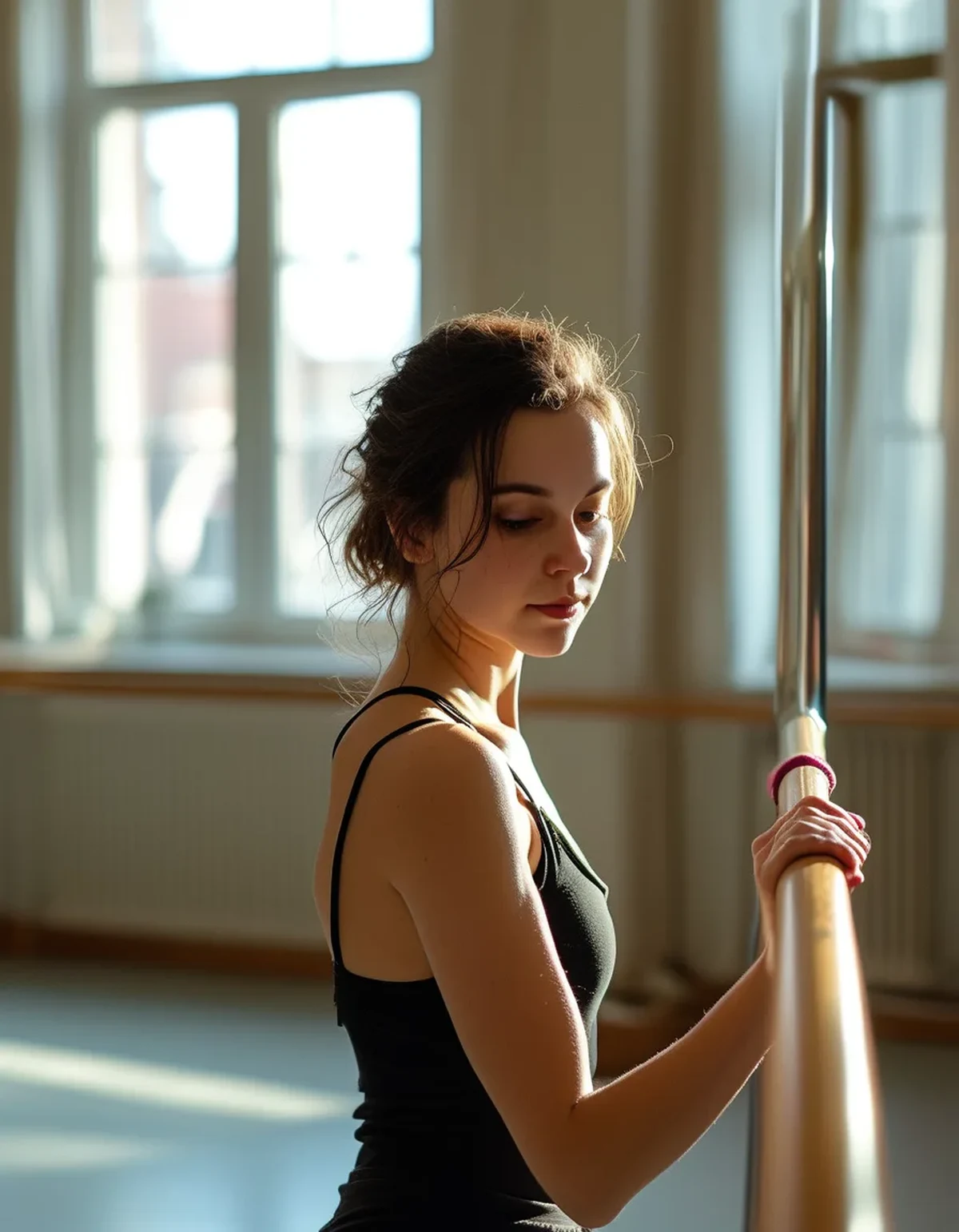
Fingertips or a light flat hand, roughly under or slightly in front of the shoulder. Not gripped, not wrapped, not white-knuckled. Imagine resting your hand on a table while writing.
Shoulder down and away from the ear. The most common visual tell of over-gripping is a raised shoulder on the barre side, frequently with a corresponding lean of the whole torso toward the barre.
Hips stay square and stacked over the standing foot. If your weight has drifted toward the barre, your standing hip is no longer directly under you and the muscles you are trying to work have partially gone offline.
Elbow soft, not locked, and not pressed down. A locked elbow pushing into the barre is a giveaway that the arm is holding weight.
Try the two-second lift test. Every so often during a standing sequence, lift your fingers a centimetre off the barre and hold for two seconds. A small correction is fine and expected. A dramatic lurch means you have been using it as support, and the exercise has been quietly getting easier all class.
And switch which hand you use when the sequence repeats. Most people have a dominant side they lean into without noticing, which builds an asymmetry into every class they take.
Myth vs Fact: Holding the Barre
Myth: Holding on tightly means you are working harder. Fact: it usually means the opposite. The grip is offloading the standing leg and the core, so the muscles you came to train are doing less, not more. The burn moves to your forearms.
Myth: Not holding on is the advanced version. Fact: light contact is the intended version for most exercises. It is not an advanced variation you graduate to - it is the standard the exercise was written for, and heavy support is the modification.
Myth: If you wobble, you are doing it wrong. Fact: small wobbles are the balance system working, which is exactly what should be happening. A completely still standing leg with a firm grip on the barre is a less useful outcome than a slightly unsteady one with fingertips.
Myth: The shakes prove you are working, regardless of grip. Fact: shaking is a normal response to sustained small-range work and fatigue, and you can produce it while still leaning heavily on the barre. Shaking is not evidence that your alignment is right.
Myth: Beginners should always hold on firmly. Fact: beginners should hold on as much as they need, and then deliberately test whether they still need it. The habit of never testing is what turns a first-week accommodation into a permanent one two years later.
How do you break a heavy grip habit?
Start with the two-second lift test in every standing sequence. Not once a class - several times, at different points. It costs nothing and it tells you the truth immediately.
Downgrade your contact one level at a time. Whole hand wrapped, to flat hand resting, to three fingers, to two fingertips. Moving one step at a time across a few weeks is far more durable than deciding to go hands-free and then quietly regripping by minute four.
Position yourself where you can see your shoulders. If your studio has mirrors, use the reflection to check for a lifted barre-side shoulder rather than to check the leg. Most people watch their working leg and never notice what their upper body is doing.
Take the standing-leg work seriously outside class. Single-leg balance while brushing your teeth, or slow single-leg sit-to-stands, build the capacity that lets you let go. Two minutes a day makes a visible difference within a few weeks.
Accept that some exercises legitimately need the barre. Deep back extensions, high leg lifts, and anything involving a rise onto the toes with a large range are supported by design. Knowing the difference is the skill.
And speak to the instructor. Asking how much you should be holding on for a specific sequence is a completely normal question, and instructors are generally delighted to be asked something other than how many more reps. If you are pregnant, returning from injury, or managing a balance-affecting condition, tell them - the answer for you may legitimately be to hold on more, and that is a considered choice rather than a habit. This is general information, not medical advice.
FAQ: Barre Grip Questions, Answered
How hard should you hold the barre?
Lightly - fingertips or a flat resting hand, with no weight going through the arm. The barre is there to tell you where vertical is, not to hold you up. If your shoulder lifts or your elbow locks, you are gripping too hard.
Is it bad to lean on the barre?
Not bad, but it changes the exercise. Leaning transfers work from your standing leg and core to your arms and shoulders, and it lets your hips drift out of position, which removes most of the benefit the movement was designed to deliver.
How do I know if I am holding on too much?
Lift your fingers off for two seconds mid-exercise. A small correction is normal and healthy. A dramatic lurch means the barre has been doing work you should be doing.
When should I hold on properly?
When you are new to a sequence, pregnant, working around an injury or a balance-affecting condition, or doing an exercise designed to be supported - deep extensions and high-range rises among them. Deliberate support is fine; unnoticed support is the problem.
TL;DR:
- The barre is a balance reference, not a support - light fingertips is the intended contact for most standing work.
- Gripping hard moves load to your arms and shoulders and lets your hips drift off the standing leg.
- Use the two-second lift test throughout class; a small correction is fine, a lurch means you were leaning.
- Downgrade contact one level at a time, switch hands on repeats, and watch your shoulder rather than your working leg.
- Some exercises are supported by design, and pregnancy, injury, or balance conditions are real reasons to hold on - just make it a choice.
Small wobbles are not a failure of the exercise. They are the exercise.
See It in Motion
Seen here: Round Neck Long Sleeve Athletic T-Shirt — shop it on bubblelime.com
Keep Reading
This article is for general informational and styling purposes only. Fit, sizing, and product availability may vary.