Why Barre Stops Working After 3 Months (and How to Break the Plateau)

Quick Answer: Barre plateaus around month 3 because your muscles have adapted to the same isometric holds and small pulses at the same tempo. Add load, change tempo, or increase range of motion — your body needs a new stimulus, not more of the same class.
Your first 8 weeks of barre were a revelation — shaking muscles, visible changes, real soreness. Then it flattened out, and you’re still going three times a week wondering why nothing’s changing anymore. Nothing’s wrong with you. Your muscles just finished adapting to exactly what you’ve been asking them to do.

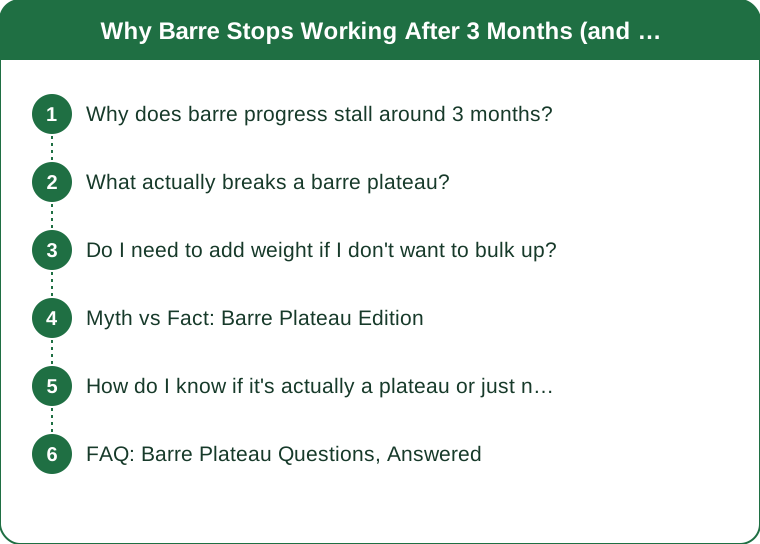
Why does barre progress stall around 3 months?
Because barre’s core tools — small isometric pulses, ballet-based holds, light or no weights — are highly effective for initial adaptation but offer limited built-in progressive overload once your muscles catch up. Your body got efficient at exactly the demand you gave it.
This isn’t a barre-specific flaw; any exercise modality plateaus without a changing stimulus. Barre just plateaus faster because the default intensity range is narrower than, say, barbell training.
What actually breaks a barre plateau?
Three levers work: increase resistance (heavier ankle weights or hand weights, typically adding 1-2 lbs at a time), change tempo (slow 4-count pulses instead of quick ones, or add explosive micro-lifts), and increase range of motion (fuller leg lifts instead of the smallest pulse range).
Rotate through these every 4-6 weeks rather than sticking with one format indefinitely.
Do I need to add weight if I don’t want to bulk up?
Barre-style loading (1-5 lb weights, high reps, isometric holds) builds lean muscle tone and endurance, not bulk — that requires a very different training stimulus (heavy compound lifts, calorie surplus). Adding a light weight to break a plateau won’t change your aesthetic outcome in the way many worry it will.

Myth vs Fact: Barre Plateau Edition
Myth: More classes per week fixes a plateau. Fact: frequency without a changed stimulus just repeats the same adaptation — you need variation, not volume.
Myth: Barre alone can’t plateau because it’s ‘full body.’ Fact: full-body doesn’t mean varied-intensity. The same rep ranges and holds across every muscle group plateau together.
Myth: A plateau means you’ve maxed out barre’s benefit. Fact: it usually means you’ve maxed out one version of barre — the third mistake most instructors don’t flag until you ask directly.
How do I know if it’s actually a plateau or just normal fluctuation?
A true plateau is 4+ weeks of no change in strength, endurance, or visible tone despite consistent attendance. Week-to-week fluctuation from sleep, stress, or cycle timing is normal and not a plateau signal — don’t overreact to a single off week.
FAQ: Barre Plateau Questions, Answered
Should I switch studios or instructors to fix a plateau?
Not necessarily — a good instructor can vary tempo and load within the same format. Ask them directly for a progression variant before assuming you need a new studio.
How much weight should I add first?
Start small — 1-2 lb increments — since barre’s high-rep isometric format amplifies even small load increases quickly.
Can I combine barre with strength training to break through?
Yes, and it’s one of the most effective fixes — adding 1-2 traditional strength sessions per week gives your body a genuinely different stimulus barre alone doesn’t provide.
TL;DR:
- Plateaus hit around month 3 because muscles adapt to the same holds, tempo, and load
- Rotate resistance, tempo, and range of motion every 4-6 weeks
- Adding light weight builds tone, not bulk — different stimulus entirely
- A true plateau is 4+ weeks flat, not one off week
Pick one lever — weight, tempo, or range — and change it in your very next class. That single variable shift is usually enough to restart visible progress within two to three weeks.
See It in Motion
Seen here: Bootcut Yoga Pants with Side Pockets — shop it on bubblelime.com
Keep Reading
This article is for general informational and styling purposes only. Fit, sizing, and product availability may vary.