Barre vs Pilates: Which Is Right for You?

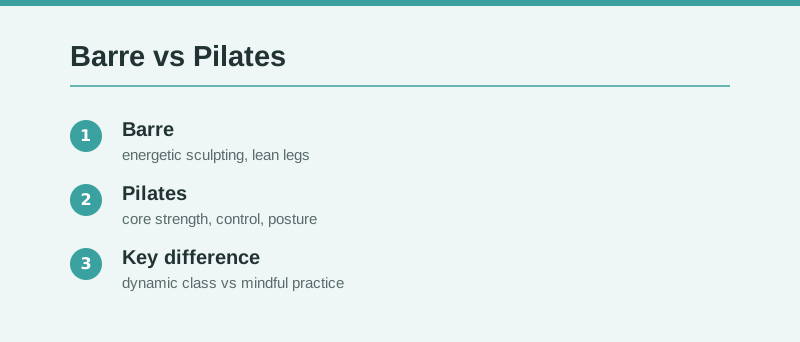
Quick Answer: Barre is high-repetition, ballet-inspired sculpting — small pulses, lots of reps, focused on legs, glutes, and core, at a faster tempo. Pilates is a methodical system built around core strength, control, and precise movement with far fewer reps. Choose barre for energetic lower-body sculpting; choose Pilates for deep core strength and posture. Doing both covers everything.
You’ve been meaning to try one of these for months. Both classes are at the same studio, both are described with the words “strengthen,” “tone,” and “lengthen,” and both cost about the same.
They are genuinely different disciplines, though, and the difference is easy to explain once someone actually does. Here’s the comparison, plus which one to book first.

What Is Barre?
Barre combines ballet-inspired positions, small pulsing movements, and high repetitions to fatigue muscles at a specific point in their range — usually somewhere in the 20 to 30 reps territory rather than the 8 to 12 of traditional strength work.
The focus is heavily on legs, glutes, and core. It’s energetic, rhythmic, usually set to upbeat music, and built around that signature deep, shaking burn that means a muscle group has genuinely had enough.
Book barre if: you want a class that feels like a workout, you like music and momentum, you’re specifically after lower-body sculpting, and you’d rather sweat than think.
What Is Pilates?
Pilates is a methodical system built around core strength, control, breath, and precise, flowing movement — developed originally as a rehabilitation and conditioning method rather than as a class format.
It emphasizes quality over quantity. A Pilates exercise might be 6 to 10 repetitions performed with exacting control, where getting the movement right is the work. The focus is deep stabilizing muscles, posture, alignment, and the mind-body connection.
Two formats worth knowing about:
- Mat Pilates — bodyweight on a mat, cheapest and most widely available
- Reformer Pilates — on a spring-loaded machine, more expensive but more adjustable, and generally more accessible for beginners and anyone working around an injury
Book Pilates if: you sit at a desk all day, you want better posture, you’re rehabbing something, or you like understanding why a movement works.

What Are the Key Differences?
| Barre | Pilates | |
|---|---|---|
| Origin | Ballet conditioning | Rehabilitation and conditioning system |
| Reps | High (20–30+) | Low, precise (6–10) |
| Tempo | Faster, rhythmic | Slower, controlled |
| Primary focus | Legs, glutes, core | Deep core, alignment, control |
| Feel | A dynamic class | A methodical practice |
| Heart rate | Moderately elevated | Generally lower |
| Equipment | A barre, light weights, a ball or band | Mat, or a reformer |
The honest summary: barre leans toward energetic sculpting; Pilates leans toward control and stability. They overlap substantially — both are low-impact, both build strength without heavy load, both improve body awareness — but the emphasis differs enough that most people prefer one clearly.
Neither is “better.” They serve different goals and suit different temperaments.

Myth vs Fact
Myth: Barre and Pilates give you “long, lean” muscles. Fact: You can’t change a muscle’s shape — muscle length is determined by where it attaches to bone. What both do is build strength and improve posture, and better posture is genuinely what most of the “longer” appearance comes from.
Myth: Pilates is just stretching. Fact: Pilates is strength work performed slowly. Anyone who’s held a proper teaser or done a set on the reformer can confirm that the low rep count isn’t the same as low effort.
Myth: You need dance experience for barre. Fact: You don’t. Ballet supplies the positions and the vocabulary, not the prerequisites — most barre regulars have never taken a dance class.
Myth: Neither one is a “real” workout. Fact: Both are legitimately hard, and both build strength. What neither one does is replace progressive resistance training or cardio — if bone density or heart health are goals, you’ll want to add those separately rather than expecting either class to cover them.
Myth: They’re basically the same thing. Fact: 25 pulses versus 8 controlled reps is a genuinely different training stimulus, even when the muscle worked is identical.
How Do You Choose?
Answer three questions:
1. What’s your goal? Lower-body sculpting and energy → barre. Core strength, posture, and control → Pilates. Managing back pain or returning from injury → Pilates, ideally reformer, with a qualified instructor.
2. What will you actually look forward to? This matters more than the technical comparison. The best workout is the one you’ll book again next week.
3. What’s available near you? A great barre instructor 10 minutes away beats an ideal Pilates studio 40 minutes away, every single time.
The most useful answer: try one class of each. Most studios offer an intro rate, and thirty minutes into each you’ll know. It’s much better data than any article.
Why Not Both?
They complement each other unusually well. Barre’s higher-rep sculpting and slightly elevated heart rate pairs neatly with Pilates’ deep stabilizing work and postural focus — one builds endurance in the big movers, the other builds control in the small stabilizers.
A practical week: 2 barre + 1 Pilates, or 2 Pilates + 1 barre, depending on which you enjoy more. If you also lift or run, one of each per week alongside is plenty.
Practical note for either: both are done barefoot or in grip socks, and both involve a lot of positions where a waistband gets tested. High waist squat-proof leggings and a supportive top will make the first class considerably less distracting than whatever’s currently in your drawer.
One caveat worth stating: if you’re pregnant, postpartum, or managing a back or joint condition, tell your instructor before class — both disciplines modify well, but only if the teacher knows. See a physical therapist first if you’re working around a specific injury.
Mini FAQ
Is barre or Pilates better for weight loss?
Neither is primarily a fat-loss tool — that’s driven mostly by overall diet and total activity. Barre burns somewhat more calories per session due to the faster tempo, but the difference is modest compared to nutrition and daily movement.
Which is better for back pain?
Pilates, generally, and reformer Pilates in particular, since it’s built around spinal stability and control and adjusts easily for limitations. Get cleared by a physical therapist first if your back pain is ongoing.
How often should you do barre or Pilates?
2–3 sessions a week is the sweet spot for either, which is enough for noticeable strength and postural changes within 6–8 weeks. Both are low-impact enough to do more frequently if you enjoy them.
TL;DR:
- Barre = ballet-inspired, high-rep pulses, faster tempo, legs/glutes/core focus.
- Pilates = methodical system, low reps, precise control, deep core and posture focus.
- Choose barre for energetic sculpting, Pilates for core strength, posture, and rehab.
- Neither replaces progressive resistance training or cardio — add those separately.
- Try one class of each, and 2–3 sessions a week of either shows results in 6–8 weeks.
See It in Motion
Seen here: UPF 50+ Short Sleeve Rashguard Swim Shirt — shop it on bubblelime.com
Keep Reading
This article is for general informational and styling purposes only. Fit, sizing, and product availability may vary.