Why Turnout Is the Barre Mistake Quietly Wrecking Your Knees
Quick Answer: Barre knee pain is most often caused by forcing turnout beyond your hip’s natural range — the knee twists to compensate for what the hip can’t give, and that torque adds up over dozens of reps. Find your real turnout by standing in parallel, then rotating only until your kneecap stops tracking over your toes.
Your instructor says “turn out from the hips,” but nobody checks whether your hips actually have that much rotation. When they don’t, your knee quietly picks up the slack — and after a few classes, that slack shows up as an ache that doesn’t go away with rest.

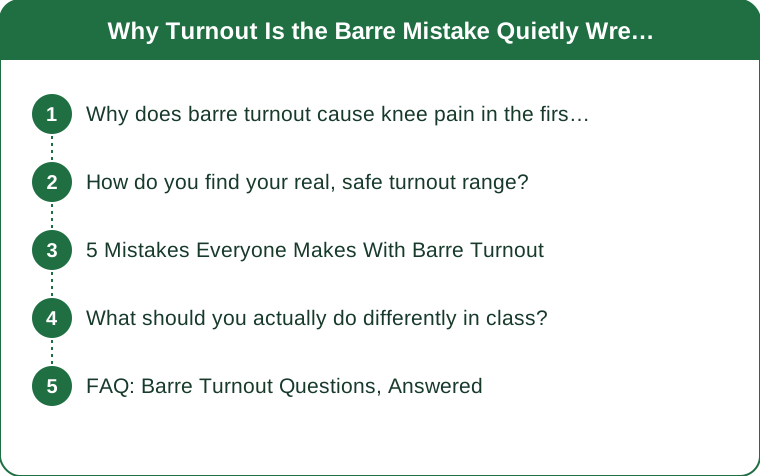
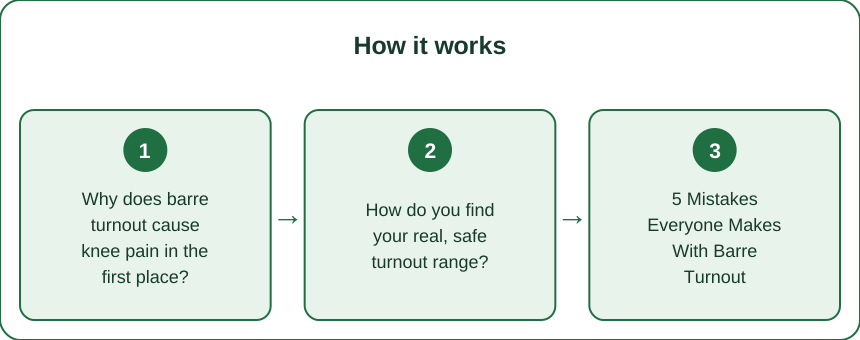
Why does barre turnout cause knee pain in the first place?
Turnout is supposed to come from external rotation at the hip joint. But hip mobility varies a lot — some people naturally rotate 60 degrees, others closer to 30. When your barre stance demands more turnout than your hips can supply, your body finds the rotation somewhere else, and the knee is the easiest joint to twist.
That twisting force, repeated through pliés and tendus for 45 minutes, is a classic overuse pattern. It rarely hurts in the first class. It shows up in week three or four, usually as an ache on the inner or outer knee after class rather than during it.
How do you find your real, safe turnout range?
Stand in parallel, feet hip-width apart, and look down at your kneecaps — they should point straight ahead over your second toe.
Now slowly rotate your legs outward using only your hips, stopping the instant your kneecap starts to lag behind your foot’s rotation (your foot turning out farther than your knee is the tell). Wherever that stopping point lands is your real turnout — for most beginners it’s noticeably less than a full first position.
That number isn’t fixed. Hip mobility work over months genuinely increases it, but forcing it in a single class doesn’t — it just borrows the range from your knee.

5 Mistakes Everyone Makes With Barre Turnout
1. Copying the front-row dancer’s angle. Years of training built that range. Your hips didn’t get the memo.
2. Turning out from the feet, not the hips. If your heels are together but your knees aren’t tracking with your toes, the rotation is coming from your ankles — that’s a different problem with the same knee-pain result.
3. Skipping the parallel check. Most people never test their real range; they just copy the class formation and hope.
4. Locking the knees at the top of a plié. Combined with over-rotation, a locked knee at full extension adds compression exactly where the twist already lives.
5. Ignoring the ache until it’s sharp. A dull post-class ache is the early warning. Sharp pain during class means stop and reassess that rep’s form.
What should you actually do differently in class?
Set your feet at your tested, honest turnout — not the studio’s floor markers. It will look like less than everyone else’s, and that’s fine; the class isn’t graded on rotation angle.
During pliés, watch your kneecaps track directly over your toes through the whole range of motion. If they start to cave inward as you go deeper, that’s your cue to come up slightly and reset rather than pushing lower.
Give your hips 2-3 dedicated mobility sessions a week outside of class — 90/90 stretches and hip external rotation work — and re-test your parallel-to-turnout range monthly. Most people see a real, sustainable increase within 6-8 weeks.
FAQ: Barre Turnout Questions, Answered
Is some knee discomfort in barre normal?
Mild fatigue in the surrounding muscles is normal. A specific ache localized to the inner or outer knee joint after most classes is not — that’s the overuse signal worth addressing with your turnout angle, not something to push through.
Can I improve my turnout permanently?
Yes — consistent hip external rotation and mobility work over 2-3 months typically increases usable turnout range. It’s a slow adaptation, similar to any joint mobility work, not a one-session fix.
Should I tell my instructor about my knee pain?
Yes, and a good one will happily give you a modified stance. This is general fitness information, not medical advice — if pain persists beyond a couple of weeks of adjusting your form, see a physical therapist.
TL;DR:
- Barre knee pain usually comes from forcing turnout past your hip’s real range
- Test your honest turnout from parallel — stop rotating when your kneecap lags your foot
- Use your tested angle in class, not the studio’s floor markers
- Build hip mobility 2-3x/week and re-test monthly; most people gain real range in 6-8 weeks
Your turnout angle isn’t a fitness score — it’s a joint-safety number, and the smaller honest one beats the bigger borrowed one every time.
See It in Motion
Seen here: High Waist Bootcut Yoga Pants with Pockets — shop it on bubblelime.com
Keep Reading
This article is for general informational and styling purposes only. Fit, sizing, and product availability may vary.