Why the Barre 'Tuck' Cue Confuses So Many Beginners

Quick Answer: The barre ‘tuck’ means a small, controlled posterior pelvic tilt that engages the deep core and glutes, not a dramatic hip curl or lower back rounding — most beginners overdo it, which flattens the natural lumbar curve and reduces the very muscle engagement the cue is meant to create.
Every beginner barre class has the same moment: the instructor says “tuck your pelvis” and half the room curls forward like they’re bracing for impact. It’s one of the most misunderstood cues in the entire barre vocabulary.

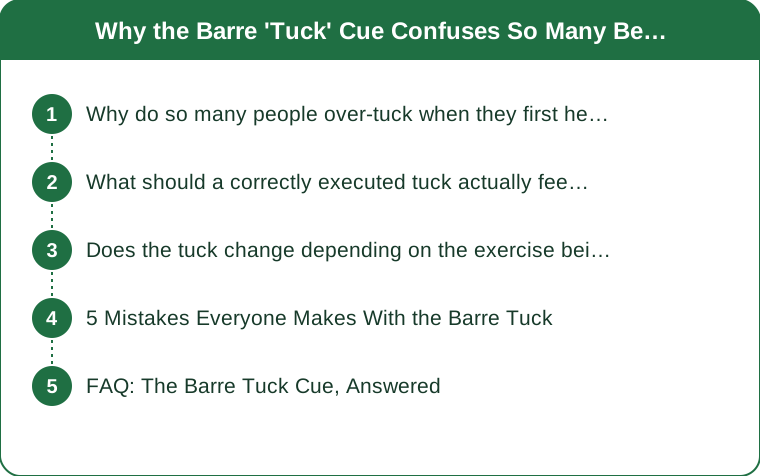
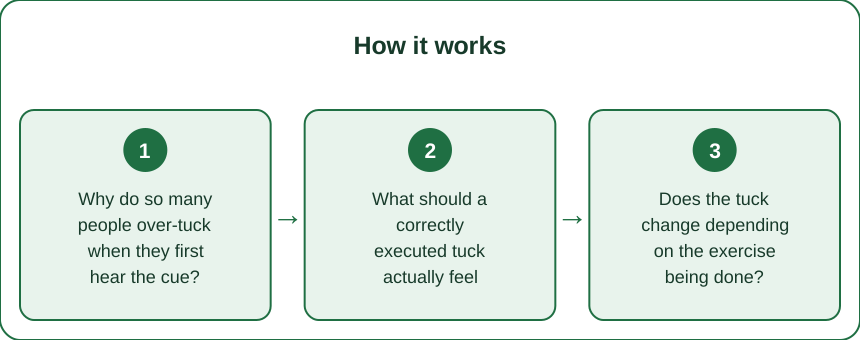
Why do so many people over-tuck when they first hear the cue?
The word “tuck” sounds like it should be a big, visible movement, so beginners tend to round the lower back and curl the hips under dramatically, when the actual movement is a subtle few degrees of pelvic rotation. Overdoing it disengages the glutes rather than activating them, which defeats the purpose of the cue entirely.
What should a correctly executed tuck actually feel like?
A proper tuck feels like a gentle squeeze of the glutes paired with drawing the belly button slightly toward the spine, not a forward hip thrust or a rounded back. Instructors sometimes describe it as “hugging a orange between your glutes” — a small, controlled engagement rather than a visible bend.

Does the tuck change depending on the exercise being done?
Yes — during standing thigh work the tuck is subtler and mostly about glute engagement, while during seated ab work it can be slightly deeper to protect the lower back under load. Instructors calibrate the cue to the exercise, which is part of why the same word can look different across a single class.
5 Mistakes Everyone Makes With the Barre Tuck
1. Rounding the whole spine instead of just the pelvis — this shifts strain into the lower back. 2. Holding the tuck so tight that breathing becomes shallow — the engagement should be firm, not rigid. 3. Tucking only during the cue and releasing immediately after — the engagement should persist through the full set. 4. Confusing tuck with tailbone-down posture in standing stretches, where a neutral spine is usually correct instead. 5. Ignoring the cue entirely because it “doesn’t feel like it’s doing anything” — subtlety is the point, not a sign it’s wrong.
FAQ: The Barre Tuck Cue, Answered
Should I feel the tuck in my lower back or my glutes?
A correct tuck is felt primarily in the glutes and deep core, not as tension or strain in the lower back — back discomfort during a tuck is a sign it’s overdone.
Is the tuck the same as what pilates calls a posterior pelvic tilt?
Essentially yes, though barre applies it more dynamically and often layers it under isometric holds, whereas pilates tends to isolate it as its own movement.
Why does my instructor keep repeating this cue if I’m already doing it?
Instructors repeat cues because the tuck tends to release gradually as fatigue sets in during a long isometric hold — the reminder is about maintaining it, not correcting a one-time mistake.
TL;DR:
- The barre tuck is a small posterior pelvic tilt, not a dramatic hip curl
- Over-tucking rounds the lower back and reduces glute engagement instead of increasing it
- The cue’s intensity shifts slightly depending on the exercise being performed
- Repeated reminders from instructors are about maintaining the tuck through fatigue, not fixing a single mistake
Once the tuck clicks, thigh work and seated ab series both feel noticeably more effective.
See It in Motion
Seen here: High Waist Bootcut Yoga Pants — shop it on bubblelime.com
Keep Reading
This article is for general informational and styling purposes only. Fit, sizing, and product availability may vary.