Why Barre Makes You Shake in Muscles You Didn't Know You Had

Quick Answer: Barre’s small, sustained isometric holds fatigue tiny stabilizer muscles that rarely get isolated in typical strength training, which is why the shaking shows up in unexpected places (deep hip rotators, inner thigh, small ankle stabilizers) rather than the large muscles you’d expect from a ‘leg workout.’
You’ve deadlifted and squatted for years without a tremor, and yet five minutes into a barre thigh sequence, your leg is visibly shaking. That’s not weakness — it’s a sign barre is targeting muscles your other training rarely reaches directly.

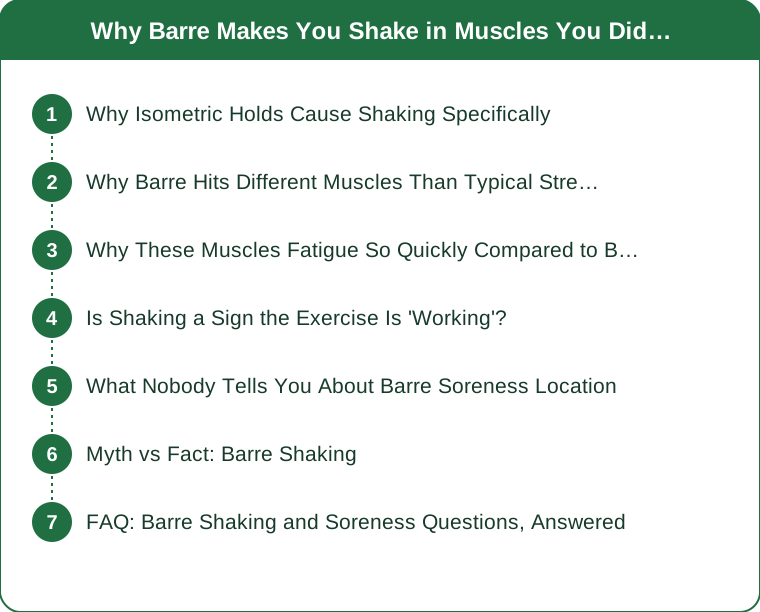
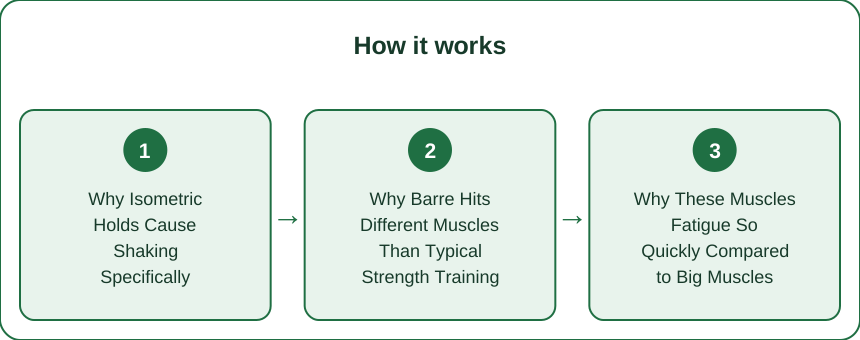
Why Isometric Holds Cause Shaking Specifically
Shaking during a sustained isometric hold happens when motor units in a muscle fire asynchronously to share the fatigue load, rather than firing in the smooth, staggered pattern seen in fresh muscle. This is a normal neuromuscular fatigue response, not a sign of instability or injury risk in most cases.
Why Barre Hits Different Muscles Than Typical Strength Training
Barre’s small range-of-motion pulses and sustained holds specifically target deep stabilizer muscles — inner thigh adductors, deep hip rotators, small ankle and foot stabilizers — that larger compound lifts (squats, lunges, deadlifts) recruit only briefly for support rather than as the primary target.
Why These Muscles Fatigue So Quickly Compared to Big Muscles
Small stabilizer muscles generally have less overall mass and lower fatigue resistance than large prime-mover muscles like the quadriceps or glutes, meaning they hit fatigue (and visible shaking) much faster under sustained isometric load, even in people who are otherwise very strong.

Is Shaking a Sign the Exercise Is ‘Working’?
Shaking indicates the targeted muscle is genuinely fatigued and working near its current capacity, which is generally a sign the exercise is appropriately challenging — but it’s not something to chase for its own sake, and stopping or modifying if shaking becomes so severe that form breaks down is the right call.
What Nobody Tells You About Barre Soreness Location
Because barre targets these smaller, less-trained stabilizers, soreness the next day often shows up in unusual spots — the inner thigh, the outer hip, small foot muscles — that don’t typically get sore from other workouts. This is part of why barre soreness can feel surprising even for people who consider themselves generally fit.
Myth vs Fact: Barre Shaking
Myth: Shaking means you’re doing the exercise wrong. Fact: shaking is a normal fatigue response in an isometric hold and usually indicates the muscle is being appropriately challenged, not that form is incorrect.
Myth: If you don’t shake, the exercise isn’t working. Fact: shaking varies by individual nervous system response and current fatigue level — its absence doesn’t mean the muscle isn’t being effectively worked.
FAQ: Barre Shaking and Soreness Questions, Answered
Should I stop when I start shaking?
Mild shaking with maintained form is fine to continue through; shaking severe enough to break your position or compromise safety is a sign to modify the hold or take a brief break.
Does shaking mean I’ll be extra sore the next day?
Often yes, especially early in a barre practice, since the targeted small stabilizers are usually under-conditioned relative to major muscle groups — this typically decreases as those muscles adapt over several weeks.
Will barre shaking decrease as I get more experienced?
Yes — as stabilizer muscles build endurance capacity over weeks of consistent practice, the same holds that caused significant shaking initially typically become more stable over time.
TL;DR:
- Shaking comes from small stabilizer muscles fatiguing during sustained isometric holds
- Barre specifically targets these deep stabilizers more than typical strength training does
- It’s a normal fatigue response, not a sign of doing the exercise wrong
- Soreness location often feels unusual because these muscles rarely get isolated elsewhere
Shaking through a barre hold isn’t a red flag — it’s a sign you’ve found muscles your regular training routine has been quietly skipping over, and they’re finally getting their turn.
See It in Motion
Seen here: High Waist Bootcut Yoga Pants — shop it on bubblelime.com
Keep Reading
This article is for general informational and styling purposes only. Fit, sizing, and product availability may vary.