When Will I See Barre Results? An Honest Timeline for the Shakes

Quick Answer: You’ll feel stronger in 2 to 3 weeks, notice real endurance gains at 6 to 8 weeks, and see visible sculpting after roughly 3 months of consistent classes. Attending 3 times a week is the single biggest variable. The “barre body in two weeks” promise is marketing, not physiology.
Somewhere around minute nineteen of your first class, thigh shaking, you will silently ask the only question that matters: when does this actually do something?
Fair question. Here’s the honest answer, without the transformation-photo theatre.

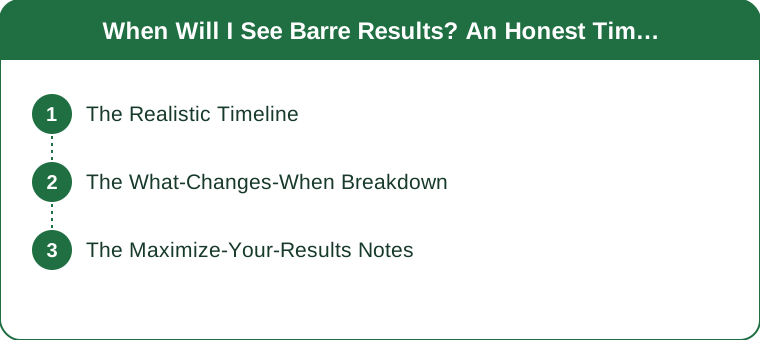
How long does it take to see barre results?
Three windows, and they don’t arrive in the order most people expect.
Weeks 1–3: it clicks. The early wins are neurological, not visible — your mind-muscle connection sharpens, your form tightens, and you stop wondering which muscle a move is supposed to hit. You feel stronger before you look different. That’s normal for every strength modality.
Weeks 6–8: it gets measurably easier. This is the real adaptation window. Exercises that wrecked you in week two are manageable. You hold positions longer, your shakes start later, and you finish class without negotiating with yourself.
Month 3 and beyond: it shows. Visible changes in muscle tone and definition take consistent months, not weeks. There is no two-week transformation. Anyone selling you one is selling you a photo, a lighting setup and a different pair of leggings.
What changes, and in what order?
- Strength and muscular endurance — early to mid. More reps, longer holds, deeper positions. The most trackable gain.
- Posture and alignment — weeks 4 to 10. Barre builds a lot of postural strength, and it’s often the change other people comment on first. Standing taller has an outsized visual effect.
- Flexibility and mobility — ongoing from week 3. The stretch-heavy structure quietly widens your range of motion.
- Balance and body awareness — weeks 6 to 12. The single-leg work develops coordination you’ll notice outside class, on stairs and curbs.
- Muscle tone and definition — month 3 onward. The slowest and most advertised. Patience is the whole strategy here.
One honest caveat: visible definition depends on body composition, which barre influences but doesn’t control. Nutrition, sleep, total daily activity and genetics all sit in that equation. Barre is one lever, and pretending otherwise is how people end up disappointed at week five.

What actually speeds up results?
Frequency, first and by a mile. Three sessions a week is the floor where the timeline above holds. Once a week, and everything stretches out roughly threefold. Showing up genuinely is the secret, however unsatisfying that is as advice.
Form over amplitude. A two-inch honest pulse with square hips outperforms a six-inch twisted one every time. Better form means a deeper burn from the same class — free progress.
Progressive challenge. Deeper holds, smaller pulses, added resistance, a heavier ball. If class feels the same in month four as it did in month two, you’ve plateaued and the fix is to make it harder on purpose.
Complementary training. Barre alone won’t give you cardiovascular fitness or heavy-load strength. Two barre sessions plus one lifting day and a couple of brisk walks covers considerably more ground than four barre classes.
Fuel and recovery. Results are built in the hours between classes. Protein at each meal and 7-plus hours of sleep aren’t a side note; they’re the other half of the mechanism.
Comfortable kit, unglamorous but real. Seat work and floor pulses are the wrong time to be fighting a waistband — high waist yoga leggings that stay put through fold-over and bridge work remove a distraction you’d otherwise spend forty minutes on.
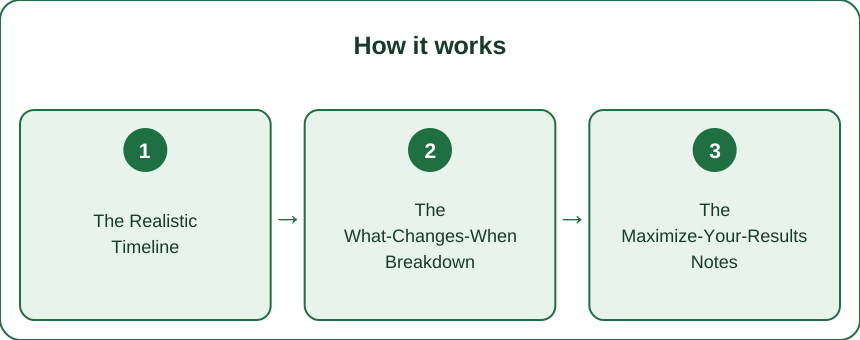
Myth vs Fact
Myth: Barre gives you long, lean muscles instead of bulky ones. Fact: You can’t change a muscle’s shape — that’s determined by where it attaches to bone. What barre does is build endurance-oriented strength without heavy loading, which reads as “toned.” The result is real; the explanation in the marketing isn’t.
Myth: If you’re not shaking, it isn’t working. Fact: Shaking means motor units are cycling through fatigue in that position. It’s a good sign, but a steady set with better form and a longer hold can be more productive than an early collapse into tremors.
Myth: Daily barre gets you there faster. Fact: Muscle adapts during recovery. Five or six sessions a week with no rest days usually produces more fatigue than progress. Three to four is the sweet spot for most people.
Myth: You’ll lose weight from barre alone. Fact: A typical class burns a moderate amount of energy. Body composition changes come from the whole picture — barre contributes, but it doesn’t do the job by itself.
How should you track progress?
Not with a scale, and not with the mirror on a random Tuesday.
Track non-scale markers instead: how many pulses before the shake starts, how deep your plié gets, whether you can hold a fold-over for the full set. Note them every two weeks. Barre results are quiet and cumulative, and these numbers move well before anything visible does.
Photos, if you take them, should be 8 weeks apart minimum — same light, same time of day, same clothes. Anything more frequent is just noise with a camera.
FAQ
How many times a week should I do barre?
Three is the practical minimum for the timeline in this article; four is a good ceiling for most people. Below three, expect everything to take about three times as long.
Do I need to do anything besides barre?
For barre-specific results, no. For overall fitness, yes — add some cardio and ideally one heavier strength session, since barre doesn’t cover either well.
Why do I feel more sore in month two than month one?
Usually because you’re finally working with enough form and depth to reach the target muscles properly. Better technique means a harder class at the same difficulty level.
TL;DR:
- Weeks 1–3: stronger and more coordinated. Weeks 6–8: measurably easier. Month 3+: visible.
- Three classes a week is the variable that decides everything.
- Strength and posture come first; visible tone comes last.
- Add cardio and heavier strength work for well-rounded fitness.
- Track pulses-before-shake and hold times, not the scale.
Show up three times a week, chase form over height, keep making it harder, and give it three months. The results are real — they’re just on a slower schedule than the ads.
See It in Motion
Seen here: Super High Waist Embossed Yoga Leggings with Inner Pocket — shop it on bubblelime.com
Keep Reading
This article is for general informational and styling purposes only. Fit, sizing, and product availability may vary.