The Barre Plateau (How to Keep Progressing After the First Few Months)

Quick Answer: Barre plateaus because the same class delivers the same stimulus while you get more efficient at it — and bodyweight work has a load ceiling. Break through by adding light weights, slowing the tempo, holding isometrics longer, using the barre less for support, and adding progressive strength training outside class. Change one variable at a time so you know what worked.
The first eight weeks of barre are magic. Everything changes, and you tell everyone.
Then month four arrives and nothing has moved in a while. The method didn’t stop working — you did the same class 60 times and got very good at it, which is the exact opposite of what progress requires.

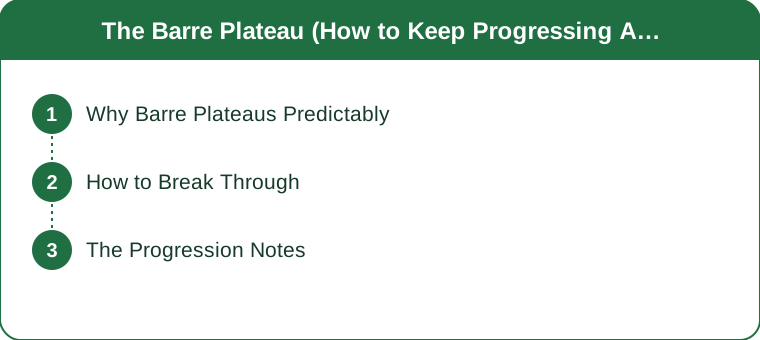
Why Does Barre Plateau So Predictably?
Your body adapts to the familiar. Adaptation is the goal, and then adaptation is the problem — once your body has adjusted to a stimulus, that same stimulus stops producing change.
The same class is the same load, forever. A format you’ve done 60 times asks exactly what it asked the first time. The class hasn’t changed; you have.
Bodyweight work has a load ceiling. You can’t add weight to your own leg. Barre’s load is largely fixed, which caps how far it can take you on strength alone — a real structural limit, not a criticism.
You get better at the moves. Improved efficiency means the same movement costs less. That’s skill acquisition working perfectly, and it makes the workout easier at exactly the point you needed it harder.
Early gains are always the fastest. Every training method front-loads results. The month-one transformation was partly barre and partly the simple fact of doing something new consistently.
The reframe: this is textbook adaptation, not a failure of the method or of you.

How Do You Break Through It?
Add external load. Swap the 1kg weights for 2kg or 3kg in arm series, and add ankle weights to leg work. The simplest fix available and the one most people skip because the studio set is right there.
Slow the tempo. Take 3 seconds down and 3 up instead of pulsing at class pace. Time under tension goes up without any equipment at all, and it’s brutally effective — try it once in a thigh series and you’ll see.
Hold the isometrics longer. When the class comes out of a hold, stay 10–15 seconds longer. You’ll be behind everyone else and considerably better trained.
Use the barre less. Fingertips instead of a grip, or let go entirely. Reducing support turns a strength exercise into a strength-plus-balance exercise, which is genuinely new stimulus for free.
Deepen the range. Go lower in the plié, further in the tuck. Range is a load variable most people leave untouched for months.
Add strength training alongside. Two sessions a week of progressive resistance work — squats, deadlifts, rows, presses — addresses barre’s load ceiling directly. This is the highest-impact item on this list by a distance.
Vary the format and the instructor. Different studios and teachers sequence differently, and a new sequence is new stimulus. Cheap novelty.
Target the series you find easiest. The one you breeze through is the one that’s stopped challenging you. Add load there first.
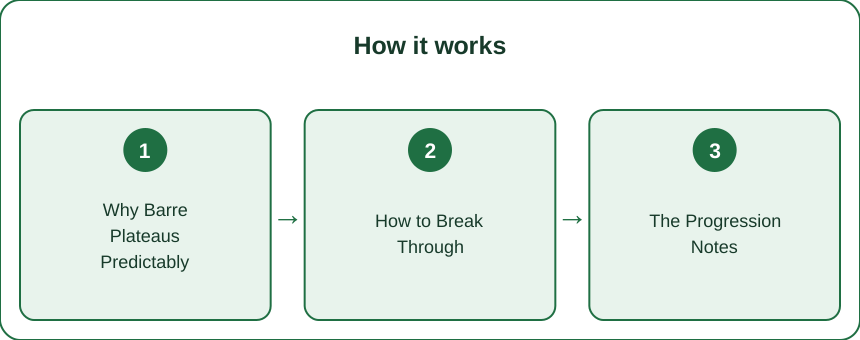
How Should You Manage the Progression?
Change one variable at a time. Add weight or slow the tempo, not both. Change three things at once and you learn nothing about which one worked.
Track what you changed and when. A note on your phone is plenty: “Week 3 — 3kg arms, ankle weights on standing leg.” Six weeks later, that note is the only way you’ll know what actually moved the needle.
Accept that barre alone has a ceiling. It’s an excellent method with a defined load limit. Recognising that isn’t disloyalty — it’s what tells you when to add something rather than grind harder at the same thing.
Let strength training complement it. They pair well: barre builds endurance, control and positional strength; progressive resistance builds the raw strength barre can’t load for.
Consistency still underpins everything. All of this assumes you’re actually attending. Three classes a week beats a perfectly optimised programme you do twice a month.
Form before intensity. Every time you add load or range, form is the first thing to degrade. Add the challenge, then check the form still holds — if it doesn’t, that’s your ceiling for now.
Recovery matters more once you’re loading. Bodyweight barre is forgiving about recovery. Barre with added weight plus two strength sessions is not — that’s a real training load and it needs real rest days.
5 Mistakes Everyone Makes at the Plateau
- Adding more classes instead of more challenge — five identical classes a week is more of the same stimulus, not a new one.
- Changing everything at once — weights, tempo, new studio, plus lifting, all in one week. Something works and you’ll never know which.
- Avoiding the hard series — the one you dread is usually the one still producing results.
- Assuming the method stopped working — it’s your adaptation, not the method’s failure.
- Skipping strength training out of loyalty to barre — the two complement each other; treating them as rivals costs you results.
Frequently Asked Questions
How long before barre results plateau?
Most people see rapid change for roughly the first 8–12 weeks, then a slowdown around months three to four. That timing is normal and predictable — it’s when the same stimulus has been fully adapted to.
Should I do barre every day?
No. More frequency of the same stimulus isn’t the fix, and daily work leaves no recovery — particularly once you’ve added load. Three to four sessions a week, progressed deliberately, beats six identical ones.
Can barre alone build real strength?
To a point, and then bodyweight’s load ceiling limits it. For continued strength gains you’ll want progressive resistance training alongside. Barre remains excellent for endurance, control, and positional strength.
Does it matter what I wear once I add weights?
Only in that you want to see your alignment as the load goes up — form is the first thing that slips. A squat-proof high waist legging with a smooth fit lets you check knee tracking and hip position in the mirror, which matters more once you’re deepening range and adding ankle weights.
TL;DR:
- The plateau is predictable adaptation: same class, same stimulus, and you’ve got more efficient at it.
- Bodyweight work has a genuine load ceiling — that’s a structural limit, not a flaw.
- Break through with heavier weights, slower tempo (3 seconds each way), longer isometric holds, less barre support, and deeper range.
- Adding two progressive strength sessions a week is the single highest-impact change.
- Change one variable at a time and write down what you changed.
- Form before intensity, and take recovery seriously once you’re actually loading.
See It in Motion
Seen here: Bootcut Capri Yoga Pants with Pockets — shop similar styles on bubblelime.com
Keep Reading
This article is for general informational and styling purposes only. Fit, sizing, and product availability may vary.