Why Barre Stops Working Around Month Three - and What to Change

Quick Answer: Barre plateaus around month three because the format’s resistance is capped by your own bodyweight and small springs, and your body adapts to a fixed stimulus within roughly eight to twelve weeks. The fix is to add load - ankle weights, heavier hand weights, single-leg variations - and to add one to two sessions a week of progressive resistance training, not to add more barre classes.
The first two months of barre are genuinely spectacular for most people. Then somewhere around week ten to fourteen, the classes stop feeling like they did, the shake arrives later or not at all, and the changes you were seeing stop arriving.
This isn’t a sign you’re doing it wrong. It’s the entirely predictable result of a format whose load ceiling is fixed - and it has a straightforward fix.

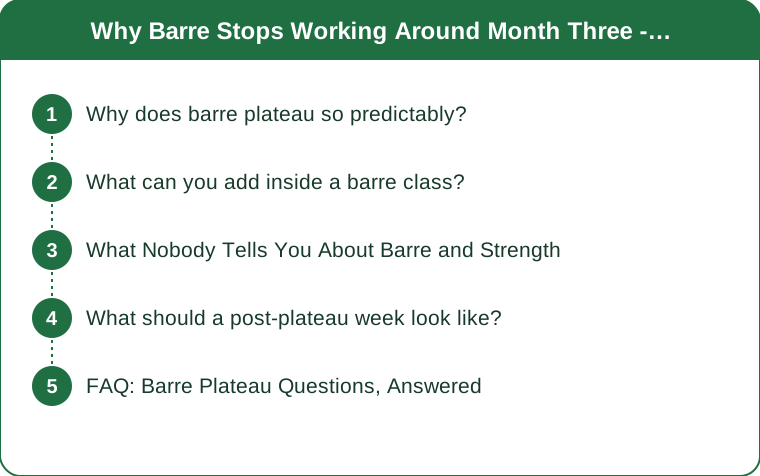
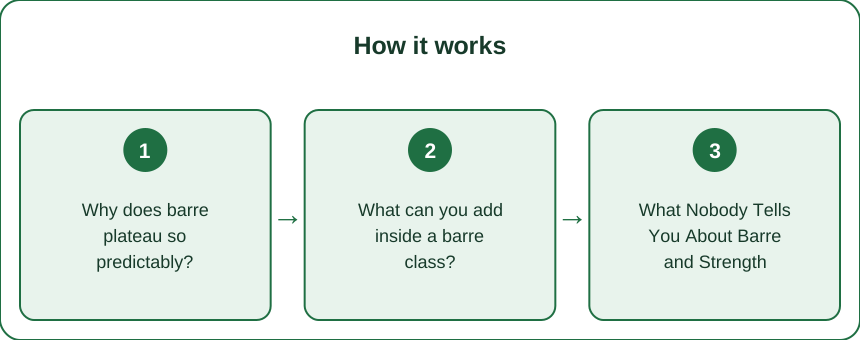
Why does barre plateau so predictably?
Because progressive overload has nowhere to go inside the format.
Muscle adapts to a stimulus and then stops adapting unless the stimulus increases. In lifting, you increase it obviously: more weight on the bar. In barre, the resistance is your bodyweight in fixed positions, plus 2 to 5 pound hand weights and a light band. Once you’ve adapted to that, there is no next rung on the ladder.
What changes in those first eight weeks is mostly neural. You get better at recruiting the muscles, better at holding positions, better at the movement patterns. That produces real, visible change and it happens fast. Neural adaptation largely plateaus in six to ten weeks - and after that, further change requires actual tissue change, which requires more load than the format provides.
The shake is a useful signal here. The shake is neuromuscular fatigue at a sustained low-load contraction. When it stops arriving, that’s not you getting weaker or lazier - it’s your nervous system having adapted to exactly this challenge. It’s a plateau indicator, not a failure.
Why more classes doesn’t fix it: going from three to five classes a week increases volume at the same intensity. Volume increases work capacity and calorie expenditure, but the strength stimulus is still capped. You get more tired without getting notably stronger.
What can you add inside a barre class?
Four things, and they cost almost nothing.
1. Ankle weights. The single most effective addition, and the one that changes the most exercises. A pair of 1 to 2 pound ankle weights transforms every standing leg series, every attitude lift, and all the tabletop work. Two pounds sounds trivial and is not - at the end of a long lever with 60 repetitions, it’s substantial.
2. Heavier hand weights. The studio’s 2 pound set is calibrated for a beginner in week one. Bring 5 pound weights, or 8 pound for the pressing and rowing sequences. If the burn arrives at rep 15 instead of rep 45, that’s not you doing it wrong - that’s the load finally being appropriate.
3. Single-leg and single-arm versions. Free load doubling. Any two-legged bridge becomes a single-leg bridge; any two-armed press becomes a single-arm press with anti-rotation. This is the most underused progression in the entire format and it requires no equipment at all.
4. Tempo and range. Slow the lowering phase to four counts. Add a two-count hold at the hardest point. Take the position an inch lower than the instructor cues. Each of these increases time under tension without any equipment.
What to say to the instructor: most are delighted by this and will suggest their own modifications. Good barre teachers know the format’s ceiling better than anyone and usually have a mental list of harder variants they don’t cue by default.

What Nobody Tells You About Barre and Strength
Four things that only become clear once you’ve been going long enough to plateau.
Barre builds endurance far more than maximum strength. High-repetition, low-load work at a small range develops muscular endurance and postural control excellently. It does not build much maximum strength, and it builds relatively little muscle mass, because the load never gets near the threshold where that happens meaningfully. This isn’t a criticism of barre - it’s what the format is for.
The ‘long lean muscle’ framing isn’t physiologically real. Muscles attach where they attach, and no exercise modality changes a muscle’s shape or length. What barre genuinely does is improve posture, control, and alignment - and better posture visibly changes your silhouette. The effect is real; the explanation usually given for it isn’t.
Bone density needs more load than barre provides. For anyone over about 35, and particularly through perimenopause, this matters. Bone responds to relatively high loads and impact. A barre-only routine is not a bone-loading routine, and this is the most consequential gap in a barre-only week.
The plateau is a sign the format worked. You adapted. That’s what was supposed to happen. The mistake isn’t the plateau - it’s interpreting it as a reason to try harder at the same thing rather than as a signal to add a different thing.
What should a post-plateau week look like?
Keep the barre. Add load elsewhere. A realistic four to five day structure:
Monday - Barre class, with ankle weights and 5 pound hand weights
Tuesday - Strength session, lower body (35-40 minutes)
- Goblet squat, 3 sets of 8
- Romanian deadlift, 3 sets of 8
- Split squat, 3 sets of 8 per leg
- Hip thrust, 3 sets of 10
- Calf raise, 2 sets of 15
Rest 90 seconds between sets. Choose a weight where the last two reps are genuinely hard. This is the part barre can’t give you.
Wednesday - Barre class or rest
Thursday - Strength session, upper body (30-35 minutes)
- Dumbbell row, 3 sets of 8 per side
- Overhead press, 3 sets of 8
- Chest press or push-up progression, 3 sets of 8
- Lat pulldown or assisted pull-up, 3 sets of 8
- Face pulls, 2 sets of 15
Friday or Saturday - Barre class
Once a week, something with impact - a brisk walk with a few short jogging intervals, skipping, or a few sets of low jumps. Bone likes impact, and barre is deliberately low-impact.
Why this works: you keep everything barre is genuinely excellent at - control, posture, endurance, the part you actually enjoy - and add the one variable the format structurally cannot provide. Most people report the barre classes themselves feeling better within a month, because the added strength makes the positions more accessible.
FAQ: Barre Plateau Questions, Answered
Will lifting weights make me bulky and undo the barre look?
No. Building substantial muscle mass requires years of dedicated high-volume training and a calorie surplus. What two lifting sessions a week produces is more strength, better bone density, and modest muscle definition - which reads as exactly the look people go to barre for.
How many barre classes a week is the sweet spot?
Two to three, alongside two strength sessions, works well for most people. Five barre classes and nothing else is where the plateau becomes permanent.
Is reformer Pilates a better alternative?
It has a higher load ceiling than barre because the springs go heavier, so it plateaus later. But it hits the same ceiling eventually for the same reason. Neither substitutes for progressive loading with weights.
Should I switch studios or formats instead?
A new format gives you another six to eight weeks of neural adaptation, which feels like progress. It’s real but it’s temporary, and you’ll arrive at the same place. Changing the load ceiling addresses the actual constraint; changing the format postpones it.
TL;DR:
- Barre plateaus at 8-12 weeks because its load ceiling is fixed and neural adaptation runs out
- More classes adds volume at the same intensity - that’s not the missing variable
- Inside class: ankle weights, 5-8 pound hand weights, single-leg versions, slower tempo
- Outside class: two progressive strength sessions a week, plus something with impact for bone
- The shake disappearing is an adaptation signal, not a sign you’re slacking
- Keep the barre - it’s excellent at control and posture, which lifting doesn’t teach
The plateau means the format did its job. What it can’t do is keep doing it forever, and adding two sessions of real load is what makes the next six months look like the first eight weeks did.
See It in Motion
Seen here: Bootcut Capri Yoga Pants with Pockets — shop similar styles on bubblelime.com
Keep Reading
This article is for general informational and styling purposes only. Fit, sizing, and product availability may vary.