The Barre Injuries Nobody Warns You About (and How to Avoid Them)

Quick Answer: Barre is low-impact, not low-risk. The five injuries that actually show up are knee strain from forcing turnout at the knee instead of the hip, lower back overarching once the core fatigues, calf and Achilles overuse from too much early relevé, hip flexor tightness, and wrist strain during floor work. Rotate from the hip socket, brace before you arch, and build relevé volume gradually — that covers most of it.
Nobody stretches before barre. Nobody talks about barre injuries. Nobody thinks a movement that travels two inches can hurt them.
Then week three arrives, your calves feel like they’ve been in a fight, and one knee has opinions it didn’t used to have. Tiny movements repeated 60 times are still load — your tissue just doesn’t get a memo saying the class was billed as gentle.
Is Barre Really as Gentle as Everyone Says?
For impact, yes. For injury risk, that’s the wrong question.
Repetition is a load variable. A pulse might move you an inch, but 60 of them in 90 seconds is real cumulative work. Volume does what weight does — it just takes longer to notice.
Isometric holds fatigue you differently. Sitting in a plié hold burns out the stabilisers that were keeping your alignment honest. Those muscles quit before the big ones do, which is why your form at minute 40 doesn’t look like your form at minute 5.
Low-impact reads as no-risk. No jumping, no barbell, so people skip the whole warm-up and progression conversation they’d never skip in a lifting class. Different risk profile isn’t the same as no risk profile.
Small ranges hide bad alignment. In a full squat, a collapsing knee is obvious to everyone in the room. In a two-inch pulse, it’s nearly invisible — including to you, and including to a busy instructor scanning 20 people.
Turnout is a genuine technical demand. Barre uses turned-out positions constantly, and they place a specific requirement on hip and knee alignment that most beginners get wrong on day one. It’s a skill, not decoration.
What Are the Most Common Barre Injuries?
Five, in rough order of how often they turn up.
Knee strain from turnout misalignment. The most frequent barre complaint by a distance. You want turnout, your hips only give you so much, so the rotation gets stolen from the knee — a joint that hinges and doesn’t rotate. Repeat that for 50 pulses and the knee gets loud.
Lower back overarching. During standing leg work, your core fatigues before the class does. The lower back steps in to hold the position, and you finish the track with a hollow arch you never intended.
Calf and Achilles overuse. Every relevé is a calf raise. Barre stacks dozens of them into every class, and the first few weeks are where the Achilles takes the hit — especially if you’ve come from a mostly flat-footed sport.
Hip flexor tightness. So much of barre is hip-flexor-dominant in a small range. The tightness builds quietly across weeks and rarely gets countered, because nobody thinks a class this gentle needs a stretch afterwards.
Wrist strain on all-fours work. The overlooked one. Floor-based core and arm sections park your bodyweight on extended wrists, and poor hand alignment turns a five-minute section into a genuinely sore joint.
The useful thing about that list: it’s specific and learnable. This isn’t “be careful” — it’s five named failure points with five named fixes.
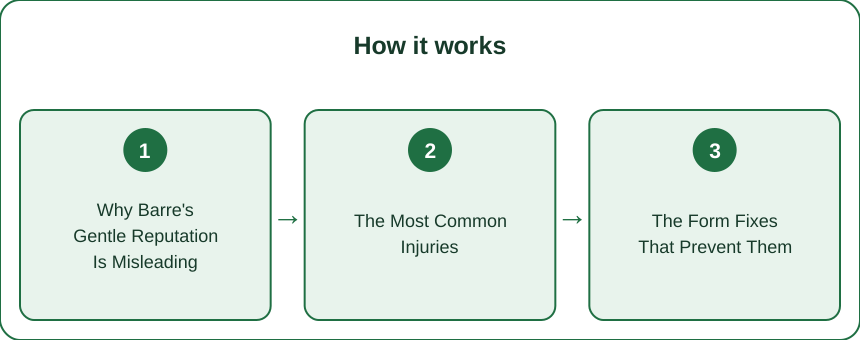
What Form Fixes Actually Prevent Them?
Turn out from the hip, never the knee. The single most important correction in this article. Initiate the rotation at the hip socket, then check that your knee tracks over your toes rather than drifting inside them. If your available turnout is 30 degrees, use 30 degrees — a smaller, honest turnout beats a wider one your knee is paying for.
Brace the core before the back arches, not after. Set the brace at the start of a standing sequence rather than rescuing your position halfway through. Ribs down, low back long. If you notice the arch appearing, that’s the cue to reset — not to push through the last 20 reps.
Build calf tolerance gradually. In your first few weeks, take some relevés flat or lower the heel between pulses. Nobody is watching, and an Achilles that’s still speaking to you in month two is worth more than a perfect first class.
Stretch hip flexors right after class. Not “at some point.” A couple of minutes of a half-kneeling hip flexor stretch, 30 seconds a side, directly counters the movement pattern you just did 200 reps of. It works because it’s specific, and it works because you’ll actually remember to do it while you’re still on the mat.
Adjust your wrists on floor work. Stack shoulders over wrists, spread the fingers, push the floor away rather than sinking into the heel of the hand. Still sore? Fold the mat under the heel of your hand, or drop to your forearms. It’s a small adjustment for a disproportionate amount of relief.
5 Mistakes Everyone Makes in Barre Class
- Chasing the widest turnout in the room — borrowing the last 20 degrees from a joint that doesn’t rotate.
- Skipping the warm-up because it’s “just barre” — cold calves plus 40 relevés is the Achilles story in full.
- Pushing through form breakdown in the last 20 reps — where the fatigue has already handed the job to your lower back.
- Doing five classes in your first week — enthusiasm outrunning tissue tolerance, which is a matter of weeks, not willpower.
- Never stretching hip flexors afterwards — the one that quietly builds all season and gets blamed on your desk chair.
Frequently Asked Questions
Why do my knees hurt after barre?
Almost always turnout taken from the knee instead of the hip. Try a narrower stance where the knee tracks cleanly over the toes for a full class and see whether the ache disappears. If it persists with clean alignment, get it looked at rather than adjusting for another month.
How often should a beginner do barre?
Two to three classes a week for the first month, with a rest day between them. The limiter isn’t your fitness — it’s calf and Achilles tolerance, which builds on a slower clock than your enthusiasm does.
Is barre safe if I already have knee problems?
Often yes, with modifications, but get clearance first and tell your instructor before class rather than after. Most knee-friendly barre comes down to reducing turnout and limiting how deep you go in plié — both easy to do without sitting anything out.
What should I wear to barre?
Something that lets the instructor see your alignment, which loose sweatpants don’t. A squat-proof high waist legging with a smooth fit is the practical choice — visible knee tracking is a real safety feature in a class where a two-inch movement can hide a misalignment. Grip socks are worth it too.
When to See a Professional
Sharp knee pain during a movement, Achilles pain that’s worse on your first steps in the morning, or wrist pain that lingers between classes are all worth a physiotherapist’s time rather than another week of hoping. Persistent lower back pain after standing work usually points to a core endurance gap that’s fixable — but it’s fixable faster with someone watching you move.
TL;DR:
- Barre is low-impact but not low-risk: high-rep pulses and isometric holds are real cumulative load.
- The five common injuries are knee strain from turnout, lower back overarching, calf/Achilles overuse, hip flexor tightness, and wrist strain.
- Rotate from the hip and keep the knee over the toes — the highest-value fix on the list.
- Brace the core before form breaks, not after, and build relevé volume across weeks rather than days.
- Stretch hip flexors 30 seconds a side straight after class; stack shoulders over wrists on floor work.
- Sharp knee pain, morning Achilles pain, or wrist pain between classes means see a physio.
See It in Motion
Seen here: High Waist Yoga Leggings with Inner Pocket — shop it on bubblelime.com
Keep Reading
This article is for general informational and styling purposes only. Fit, sizing, and product availability may vary.