Your First Barre Class: What Actually Happens (Tiny Pulses, Big Feelings)

Quick Answer: Expect small pulsing movements, light weights that feel absurdly heavy within minutes, and your legs shaking uncontrollably — all of which is normal and expected. Bring or buy sticky socks, arrive 10 minutes early to tell the instructor it’s your first class, and stand center-back. Class one is survival; things start clicking around class four.
Barre from the outside: elegant people pulsing one inch at a time to upbeat music, looking composed.
Barre from the inside: your leg is on fire, the inch is a lie, and you have never felt more connected to a room of strangers.
If you’re thinking about booking your first class, here’s what actually happens — and why the shaking is the part you’re supposed to want.

What Is a Barre Class, Actually?
Barre borrows positions from ballet, but it isn’t dance and there’s no choreography to learn. It’s a low-impact strength class built around isometric holds and very small ranges of motion, usually done to music with a ballet barre for support.
A typical hour runs roughly like this: a warm-up with some light cardio, an arms section with small weights, a thigh section at the barre, a glute section, core work on the mat, and a stretch at the end.
Nothing is complicated. Everything is repeated a great many times. That’s the entire design.
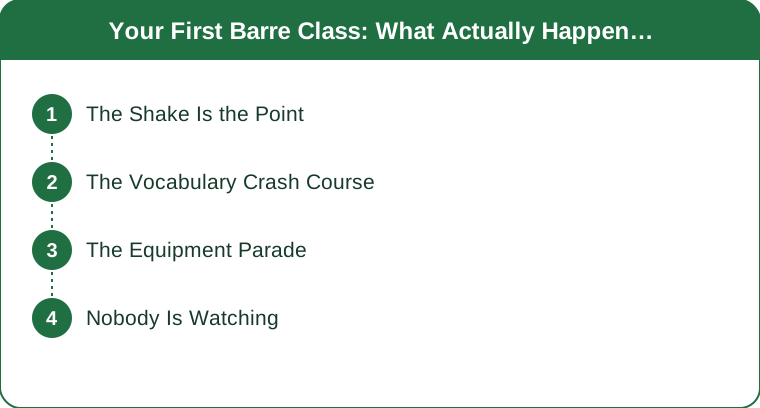
The Shake Is the Point
Around rep thirty of a tiny pulse, your leg will start vibrating like a phone on silent.
This is normal, expected, and in barre culture it’s essentially applause.
What’s happening: sustained low-load contraction fatigues the muscle fibers currently working, and your nervous system recruits additional motor units to keep the position. The recruitment happens in slightly uncoordinated bursts, and the visible result is shaking.
What it isn’t: a sign you’re doing it wrong, that something is about to give out, or that you’re unfit. Regulars shake too. Instructors shake.
What to do about it: nothing. Stay in the position if you can, come out for a few seconds if you need to, and go back in. Both are correct.
The only shake worth stopping for is one accompanied by sharp pain, joint pain, or dizziness — which is a different signal entirely.
The Vocabulary Crash Course
You’ll hear about eight terms and you can fake all of them by song three.
Tuck. Tilt your pelvis forward and up, like zipping tight jeans. It’s the most-cued and least-intuitive instruction in barre. You’ll get it around week two.
First position. Heels together, toes turned out, comfortably — not to whatever angle you saw in a ballet documentary.
Pulse. Move about an inch. Feel considerably more than an inch.
Hold. Stop moving and stay exactly where you are. Frequently harder than the pulsing.
Parallel. Feet hip-width, toes forward. The opposite of turned out.
Relevé. Up onto the balls of your feet.
Second position. Feet wide, toes turned out. Where thigh work usually lives.
Seat work. Glutes. Always more than you expect.
The Equipment Parade
Light weights — usually two or three pounds. You will look at them skeptically. They will humble you by minute four of the arms section. This is a rite of passage, not a scandal, and everyone experiences it once.
A soft ball that goes between your thighs to be squeezed relentlessly. It looks friendly. It is not.
A resistance band, sometimes, for glute work.
Sticky socks — grip socks with rubber dots on the sole. Most studios require them and sell them at the desk for around $12–18. Check the studio’s website beforehand; showing up without them is the most common first-timer hiccup.
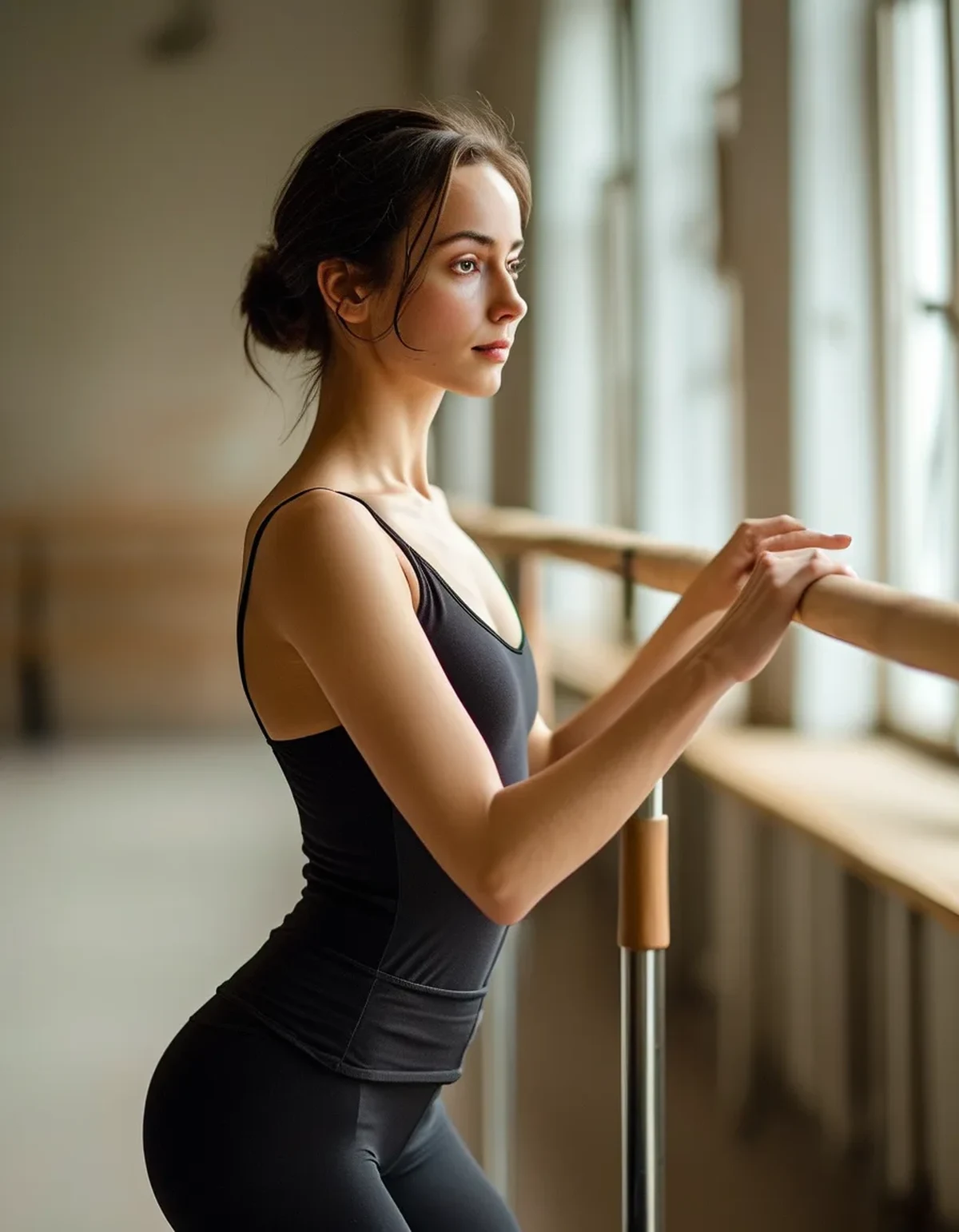
What to wear: fitted leggings and a top that stays put when you bend forward. Instructors need to see your knee and hip alignment, so anything very loose makes their job harder. High-waisted leggings with a wide waistband are the practical choice here — there’s a lot of hinging and folding forward, and you don’t want to be adjusting anything mid-pulse.
Nobody Is Watching You
Genuinely. Everyone in that room is staring at their own trembling leg in the mirror, conducting a private negotiation with gravity.
The room’s judgment budget is zero, and this is the single most common thing that stops people booking a first class.
A few practical things that help anyway:
Arrive 10 minutes early and tell the instructor it’s your first class. They’ll show you the equipment, give you a spot, and check on you during the hour. Every instructor wants this — a first-timer who says nothing is much harder to help.
Stand center-back. You can see the instructor and the people around you, and you’re not in the front row learning the vocabulary in public.
Take breaks whenever. Coming out of a position, shaking out a leg, and going back in is completely normal and nobody registers it.
Tell them about injuries. Barre has modifications for nearly everything — knee issues, wrist issues, pregnancy, back problems. If you’re pregnant, postpartum, or working around an injury, mention it before class and check with your doctor or physical therapist first if it’s recent.
What the First Few Weeks Feel Like
Class one: survival. You won’t know the vocabulary, you’ll be half a beat behind, and your legs will shake constantly. Expected.
Classes two and three: still hard, less confusing. The sequence starts feeling familiar. You’ll anticipate the thigh section with mild dread, which is progress.
Class four: the click. The tuck makes sense. You know what’s coming. You start choosing to hold rather than surviving the hold.
Class ten: you’re the one explaining the shake to a first-timer.
Expect meaningful soreness after class one, particularly in your glutes and inner thighs — often peaking about 48 hours later. That’s normal delayed-onset soreness. Two or three classes a week is a good rhythm; give yourself at least a day between the first two.
Myth vs Fact
Myth: You need dance or ballet experience. Fact: Barre borrows ballet’s positions and none of its choreography. Instructors teach every position from scratch, every class, because most of the room has never danced.
Myth: Two-pound weights can’t do anything. Fact: High-repetition, small-range work under continuous tension is a genuinely different stimulus from heavy lifting, and it’s brutal in its own way. You’ll believe this by minute four.
Myth: The shaking means you should stop. Fact: It means your nervous system is recruiting more muscle fibers to hold the position. Stop for sharp pain or dizziness — not for shaking.
Myth: Barre is a full strength program on its own. Fact: It’s excellent muscular endurance and core work, but it won’t build maximal strength or bone density the way progressive heavy lifting does. Pair it with something that loads you heavily once or twice a week.
Mini FAQ
What should I wear to my first barre class?
Fitted leggings, a top that stays in place when you bend over, and grip socks. Most studios require grip socks and sell them at the desk. Skip loose shorts and baggy tops — instructors need to see your alignment to correct it.
Is barre good for beginners?
Yes. It’s low-impact, everything is modifiable, and there’s no choreography to learn. The movements are small and repeated, so you have plenty of chances to find each one. It’s demanding, but the demand comes from repetition rather than complexity.
Why do my legs shake so much in barre?
Sustained low-load holds fatigue the working muscle fibers, and your nervous system recruits additional ones in uneven bursts to maintain the position. The visible shake is that recruitment. It’s expected, it happens to regulars too, and it settles as you build endurance over several weeks.
TL;DR:
- Barre is low-impact strength work built on tiny ranges and lots of repetition — no choreography.
- The leg shake is muscle fiber recruitment. It’s normal and it’s the point.
- Two-pound weights will humble you. Everyone. Every time.
- Grip socks are usually required — check the studio site and arrive 10 minutes early.
- Stand center-back, tell the instructor it’s your first class, and take breaks freely. Class four is when it clicks.
Shake proudly, tuck approximately, respect the two-pound weights. Class one is survival, class four is rhythm, class ten is you explaining the shake to someone new. Book it.
See It in Motion
Seen here: High Waist Bootcut Yoga Pants — shop it on bubblelime.com
Keep Reading
This article is for general informational and styling purposes only. Fit, sizing, and product availability may vary.