Why Runners Who Add Barre Get Faster Without Running More

Quick Answer: Barre helps runners primarily through lateral hip strength, single-leg stability, and ankle and foot control - three areas running trains poorly because it is a repetitive forward-plane activity. Two sessions weekly is the useful dose. It will not build the maximal strength that heavy lifting provides, and it is not cardiovascular training.
Runners tend to arrive at barre for the wrong reason - a rest day that still feels productive - and stay for a better one. The overlap between the two is more specific than general fitness, and knowing exactly where it sits makes the sessions considerably more useful.

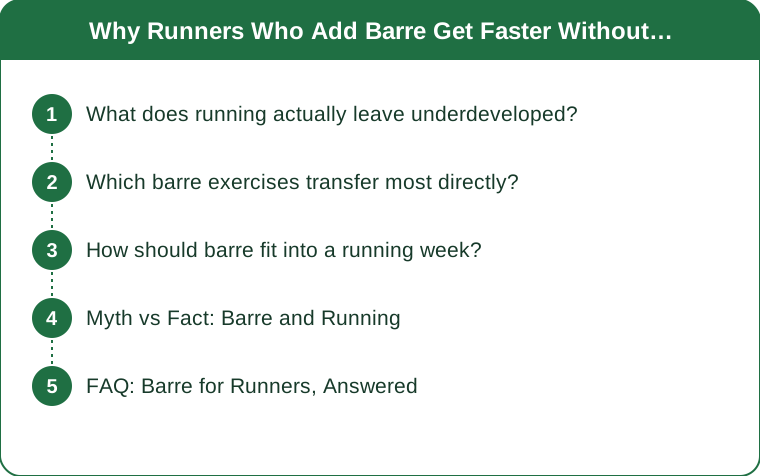
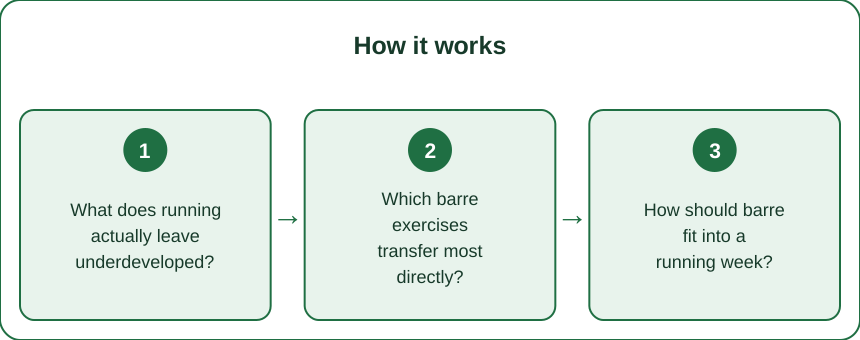
What does running actually leave underdeveloped?
Running is a repetitive, single-plane, single-leg activity. Everything it trains well follows from that, and so does everything it neglects.
Underdeveloped area 1: the lateral hip. The gluteus medius and minimus control how much your pelvis drops and how much your knee tracks inward when you land on one leg. Running loads them but rarely challenges them through range, so they get repetitively used rather than developed. Weakness here is associated with a lot of the running complaints that end up in physiotherapy - the knee pain that comes from the hip and the IT band irritation that comes from the same place.
Underdeveloped area 2: single-leg stability under fatigue. Every running stride is single-leg support, but it is fast and momentum carries you through. The slow, controlled single-leg work in barre exposes stability gaps that speed hides.
Underdeveloped area 3: the foot and ankle in small ranges. Barre spends a great deal of time in relevé - heels lifted, weight on the ball of the foot - which loads the intrinsic foot muscles and calf complex in a way that steady running does not.
What running trains perfectly well and does not need help with: the sagittal plane push-off, aerobic capacity, and forward-plane endurance. Cross-training that duplicates these is largely wasted time.
That is the whole logic. Barre is useful to runners in inverse proportion to how much a movement resembles running.
Which barre exercises transfer most directly?
Not all of a barre class earns its place for a runner. These are the sections worth paying full attention to.
Standing seat work with the leg extended behind or to the side. This is direct gluteus medius and maximus loading in exactly the positions running neglects. When the instructor cues small pulses at the top of a lifted leg, that is the highest-value minute in the class for you.
Single-leg balance and standing series. Anything performed on one leg with the other lifted, especially with small ranges of motion held. The shaking is the point - it is the stabilisers working at a duration they never see in running.
Relevé and heel raise work. Calf and foot endurance in a controlled range. Runners with a history of Achilles or calf trouble often find this section the most immediately noticeable in their running.
Core work in the plank family. Trunk stability determines how much energy leaks laterally during a stride, and it becomes measurably more important as a run gets long and form degrades.
Lower priority for runners:
- Arm work with light weights - pleasant, not particularly transferable
- Deep quad-dominant sequences - runners rarely lack quad endurance
- Extended stretch sections - useful, but no more so than stretching anywhere else
A practical approach: treat the standing leg work as your session and the rest as a bonus. If you can only attend one class a week, choose the one with the longest standing series.

How should barre fit into a running week?
Two sessions weekly is the effective dose for most recreational runners, and placement matters more than people expect.
Where to place them:
- Not the day before a quality run. Barre creates real fatigue in the stabilisers, and a hard interval session on tired glutes is worse quality and slightly riskier.
- Good on an easy run day, either separated by several hours or done after the run.
- Good on a full rest day, provided you accept it is not really a rest day for your hips.
- Avoid the two days before a race. The soreness in unexpected places is real and unhelpfully timed.
A sample week for someone running four times:
- Mon: easy run + barre (evening)
- Tue: intervals or tempo
- Wed: rest or walk
- Thu: easy run
- Fri: barre
- Sat: rest
- Sun: long run
Expect the first three or four sessions to affect your running. Sore glutes and calves change your stride, and people often report their runs feeling worse for a fortnight before feeling better. Reduce running intensity slightly during the first two weeks rather than trying to hold both.
The timeline for noticing something: strength and stability changes generally show up in running around week 6 to 8. What people typically report first is not speed but that the last few miles of a long run hold form better - which is exactly what improved stabiliser endurance should produce.
Myth vs Fact: Barre and Running
Myth: Barre is a cardio workout that can replace an easy run. Fact: heart rate rises during barre, but the sustained aerobic stimulus is nothing like a run. Treat it as strength work with an elevated heart rate. Replacing running volume with barre volume will reduce your running fitness.
Myth: Barre builds long, lean muscles rather than bulky ones. Fact: muscle shape is determined by your skeleton and muscle attachment points, and no exercise changes muscle length. Barre builds endurance and stability rather than size because of its high-repetition low-load format - which is a real and useful distinction, just not the one the marketing describes.
Myth: Barre is too gentle to help serious runners. Fact: anyone who has held a proper standing seat series knows the intensity is real. What is true is that barre is low load, high repetition, which builds endurance-type strength rather than maximal strength.
Myth: If you do barre you do not need to lift. Fact: this is the most important one. Barre does not replace heavy resistance training, and the evidence for heavy strength work improving running economy in distance runners is reasonably solid. Squats and deadlifts at meaningful loads do something barre does not. Ideally you do both - lifting once or twice weekly and barre once or twice.
Myth: The shaking means you are damaging something. Fact: shaking during sustained small-range work is neuromuscular fatigue, which is expected and is broadly the signal that you are in the working range. Sharp pain is different and should stop the movement.
FAQ: Barre for Runners, Answered
Will barre help with runner’s knee?
It may help, because a common contributor is lateral hip weakness allowing the knee to collapse inward, and barre trains that directly. It is not a diagnosis or a treatment - persistent knee pain deserves an assessment before you self-prescribe.
Should I do barre during marathon training?
Yes, and it is arguably more valuable then than in the off-season, because form degradation over long distances is a stability problem. Reduce to one session weekly during the highest-volume weeks and drop it in the final ten days.
Is barre better than Pilates for runners?
They overlap considerably. Barre spends more time in standing single-leg positions, which is closer to running. Pilates has more spine and deep core work. If you have a specific stability weakness, barre is the closer match; both are far better than neither.
How long before I notice something in my running?
Six to eight weeks for most people, and what you notice first is usually form holding together late in a run rather than a change in pace.
Can I do barre at home instead of a studio?
Yes - the equipment requirement is a chair back and floor space. What you lose is the correction, and barre is a format where small positional errors change which muscle is doing the work. A few in-person classes first makes home sessions considerably more effective. This is general information, not medical advice.
TL;DR:
- Barre helps runners where running is weakest: lateral hips, single-leg stability, and foot and ankle control
- The standing seat and single-leg series are the high-value sections; arm work is a bonus
- Two sessions weekly, placed away from quality runs and race weeks
- It does not replace heavy lifting or cardiovascular training - it complements both
- Expect six to eight weeks before it shows up in your running, usually as better form late in a long run
The runners who get the most from barre are the ones who stop treating it as a soft day and start treating it as targeted stability work. Pick the class with the longest standing series, hold the positions honestly, and let the shaking do its job.
See It in Motion
Seen here: High Waist Yoga Leggings with Side Pockets — shop it on bubblelime.com
Keep Reading
This article is for general informational and styling purposes only. Fit, sizing, and product availability may vary.