A Barre Arms Workout You Can Do With No Weights

Quick Answer: Barre arms work through high-rep, small-range pulses, circles and isometric holds that keep muscles under constant tension — no weights required. A complete sequence takes under 10 minutes and works well done 2-3 times a week. The burn arrives around the 30-second mark and is the entire point.
You raise your arms out to the sides. Easy. You start pulsing them an inch at a time. Still easy. Somewhere around second forty, your shoulders begin filing a formal complaint, and you understand why people leave barre classes walking slightly differently.
Barre has a reputation for producing long, lean, sculpted arms — and the surprising part is how little you need to get there. No heavy dumbbells, no machines, just your own bodyweight and the deceptively brutal magic of tiny, controlled pulses.

Why Do Tiny Movements Burn So Much?
Because they never let the muscle rest.
In a normal dumbbell curl there’s a moment at the top and bottom where tension drops off. Barre removes that moment entirely. High repetitions of small, precise movements keep the muscle under constant tension for 45-90 seconds at a stretch, which is a very different demand from lifting heavy for eight reps.
Instead of asking a muscle to be strong, you’re asking it to endure. That’s an endurance and metabolic challenge — the burning sensation, the shaking, the very specific feeling that your arms have been replaced with someone else’s. It feels gentle for about thirty seconds, then it very much doesn’t.
Small-range work also means low joint load, which is why barre arms sequences can be done frequently without the recovery bill of heavy pressing.
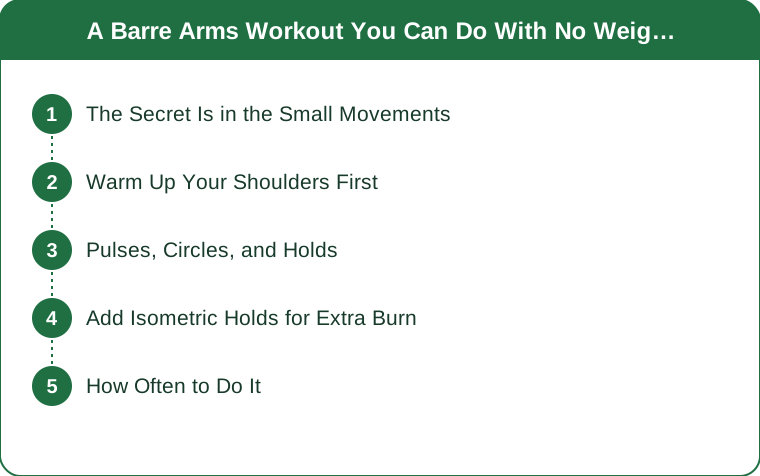
How Should You Warm Up First?
Give this 60-90 seconds. It genuinely matters, because you’re about to do several hundred repetitions.
- Shoulder rolls — 10 backwards, 10 forwards, slow.
- Arm circles — 15 small circles each direction, then 10 larger ones.
- Overhead reaches — reach one arm up, lengthen through the side body, alternate for 10 total.
- Cat-cow or a few shoulder blade squeezes — wakes up the upper back so it can share the work.
Warm, mobile shoulders keep a high-repetition format comfortable. Skip this and the first pulse sequence does the warming up for you, badly.

The No-Weight Barre Arms Sequence
Move through this without dropping your arms between exercises. That continuity is the workout.
1. Wide pulses — 45 seconds. Arms straight out to the sides at shoulder height, palms down. Pulse them up in tiny one-inch increments. Fast, small, controlled.
2. Small circles forward — 30 seconds. Same arm position. Circle the size of a grapefruit, not a beach ball.
3. Small circles back — 30 seconds. Reverse direction without lowering.
4. Palms-up pulses — 30 seconds. Rotate palms to face the ceiling and pulse up again. The rotation changes which fibers are working, and you’ll feel it immediately.
5. Static hold — 30 seconds. Arms out, absolutely still. This is where the shake shows up. The shake is fatigue, which is the goal.
6. Prayer press — 45 seconds. Palms together in front of your chest, elbows out. Press your hands into each other hard and hold. No movement, enormous burn.
7. Overhead press-together — 30 seconds. Same idea, arms extended overhead, pressing palms into one another.
8. Front-and-back pulses — 45 seconds. Arms straight in front at shoulder height, pulse up; then sweep them behind you, palms facing in, and pulse up again.
9. Shake it out — 20 seconds. Then repeat the whole sequence once more if you want a full 10 minutes.
Thirty seconds of an isometric hold feels like a lifetime. That’s how you know it’s working, and it’s also the reason nobody does these while watching a subtitled film.
What Nobody Tells You About Barre Arms
The shaking is not a fitness verdict. Your muscles shake when motor units fatigue and start firing in a less coordinated pattern under sustained tension. Very fit people shake in barre. Dancers shake in barre.
You won’t build much raw strength this way. Barre arms build muscular endurance and definition, not maximal strength. If you want to press heavier or do a pull-up, you still need progressive loading with actual weight. Barre complements that beautifully — it doesn’t replace it.
“Toned” is mostly muscle plus lower body fat. No exercise spot-reduces fat from arms. What barre gives you is the muscle underneath; overall nutrition and total activity handle the rest. Anyone telling you a pulse sequence melts arm fat specifically is selling something.
Frequency beats duration here. Ten minutes three times a week outperforms one heroic thirty-minute session, because endurance-format work recovers quickly and responds to repeated exposure.
Your form quietly degrades as you fatigue. Arms creep downward, shoulders climb toward ears, the range gets sloppy. Checking in at the 30-second mark of every exercise is worth more than adding another set.
How Often Should You Do This?
The full sequence takes under ten minutes, so 2-3 times a week slots in easily alongside whatever else you’re doing. Arms respond well to frequency, and the no-equipment format removes every excuse about gyms and travel.
You can do it at a real barre, holding a countertop, or with nothing at all. A hallway works. So does a hotel room, which is where this sequence earns most of its loyalty.
What to wear matters less here than in most workouts, with one exception: you’ll be raising your arms overhead repeatedly, so a top that stays down and a waistband that doesn’t need resetting keep you focused on the burn instead of your outfit. A fitted set with a high waist yoga pant is the standard barre uniform for exactly that reason — nothing to adjust for ten straight minutes.
A balance note, and when to see a professional: high-repetition overhead work isn’t ideal for everyone. If you have a history of shoulder impingement, rotator cuff issues, or neck problems, get a physical therapist’s input before adding a lot of overhead pulsing. Sharp or pinching pain — as opposed to muscular burning — means stop, not push through.
FAQ
Can you really tone your arms without weights?
Yes, for definition and endurance. High-rep, constant-tension work builds real muscular endurance and visible muscle tone in the shoulders and arms. What it won’t do is build maximal strength — for that you eventually need to add load.
How long until I see results from barre arms?
Most people feel a difference in endurance within 2-3 weeks of doing the sequence 3× weekly, and notice visible definition around 8-12 weeks, depending heavily on overall body composition. The soreness in week one is not a preview of the timeline — that fades fast.
Why do my arms shake so much during barre?
Sustained tension fatigues your motor units, and as they tire they fire less smoothly, which shows up as shaking. It’s a normal physiological response, it happens to fit people, and it usually signals you’re near the productive end of a set rather than doing something wrong.
TL;DR
- Barre arms work through constant tension, not heavy load — pulses, circles and isometric holds.
- Warm up your shoulders for 60-90 seconds before starting. Non-negotiable at these rep counts.
- The full sequence is 9 moves, under 10 minutes, done without lowering your arms between exercises.
- Do it 2-3× weekly. Frequency beats duration for endurance-format training.
- It builds definition and endurance, not maximum strength — pair it with real loading if strength is the goal.
- The shake is normal. Sharp shoulder pain is not — that’s a professional’s question.
See It in Motion
Seen here: Super High Waist Embossed Yoga Leggings with Inner Pocket — shop it on bubblelime.com
Keep Reading
This article is for general informational and styling purposes only. Fit, sizing, and product availability may vary.